Friday, July 14, 2023

Book Stack ~ June 2023


 A monthly post about what I've been reading.


I started this month with a couple of fun mysteries by JS Borthwick, a writer I'd never heard of--despiete her having been a Maine writer--until I ran across her works in a used bookstore. I read her first and third installment of her Sarah Dean series. They're pretty entertaining, in the traditional mystery style, with some humor mixed in. I especially liked The Case of the Hook-Billed Kites, because it has a bird-watching theme, although I admit to getting confused by the many many characters. The Student Body was amusing because of the college that's a thinly veiled fictionalization of one of Maine's elite schools.

After that, I moved onto books related to our summer trip to Slovenia and Croatia. The first was The Hired Man, by Aminatta Forna, a novel follows the story of a man in a remote Croation town, who hires on to help restore the nearby abandoned house that a woman from England and her two teenage children move into. As he repairs the house and helps the daughter bring to life a covered mosaic, he revisits in his mind his childhood and young adulthood, recounting a friendship with the two children who lived next door and how one of those relationships blossomed and the other deteriorated. It has the tightly wound suspense of a mystery, as we sense that something very bad happened, but we don't know what or why.

I admit to not reading all 1,000 pages of Black Lamb and Grey Falcon, the classic travel account of Yugoslavia by Rebecca West, written in 1937. But I did read the parts relevant to our vacation, or a little less than 300 pages. It's a fascinating account of the region's history, people, and landscape. Maybe I'll read the rest when I get home.

Finally, I read Rick Steves' Europe 101: History & Art for the Traveler, by Rick Steves and Gene Openshaw. I took two semesters of Western Civilization in college, but that was a lot of years ago, and not a whole lot of what I'd learned stuck to the old gray cells, and I never took the opportunity to take Art History. So reading this book was both a great refresher and an introduction to art and architecture about which I only had a glancing knowledge. It's also laced with dorky but amusing dad jokes (eg., they call the Medieval dread with which the end of the 10th century was approached "Y1K." Har har.). It inspired me to want to visit a LOT more of Europe, where much of the continent's art and architecture are housed. Gotta keep on traveling.


Friday, July 7, 2023

Look, Ma! No Hands!

Twenty-two years ago, I sat on the purple velvet couch in our sweet apartment in Gardiner--the one with the high ceilings, tall windows, and claw-foot tub--with a hot, sticky, diaper-clad baby glued to my own hot, stick body and a fan blowing directly at us in our second-floor apartment in with all those south- and west-facing windows. It was July and it was hot, and that hot, sticky baby didn't want to be anywhere but glued to me. 


I'm certain that in that moment, I believed I was living my permanent reality--that I'd been glued to a hot, sticky baby since the beginning of time and I would be glued to a hot, sticky baby for all of eternity. At a time when he wouldn't even let me lay him down of his blanket on the floor (where surely it was cooler than it was attached to me), I couldn't imagine that one day he would walk and talk and ride a bike. Perhaps, if pressed, I could have acknowledged intellectually that yes, one day this little ball of sweat and misery would one day graduate college. But viscerally? No. We were as we always were and always would be, eking scant relief from an oscillating fan. I had no way of knowing that every hot, sticky day he was imperceptibly but inexorably moving away from me.

And then that day passed, and the next, and the next, and, more than 8,000 days later the inconceivable (in that moment) happened: the baby had become a man. His bald head had grown blond hair. His blue eyes stayed blue. He had learned to walk and talk and ride a bike. He had gone to school and learned to drive and traveled around Europe on his own. On the day after his twenty-second birthday, he walked across a stage and accepted his college diploma.

I brought a box of tissues with me to graduation, expecting (after a weepy moment at baccalaureate the previous day) to be a blubbering mess. But as it turned out I felt no sadness or nostalgia, but only pure joy and pride and amazement. Perhaps it was that the college had pulled out all the stops to make it a lively, joyous occasion (to the extent of ensuring--somehow; I'm certain they have the resources to do it--that the rain poured only during the night and that both baccalaureate and graduation took place in spectacular sunshine). Perhaps I was distracted by the logistics of orchestrating a large and varied group of people who had come out to celebrate with us. Perhaps any sadness I might have felt was tempered by the mountain of his personal possessions that we'd moved out of his dorm room and back into our house over the previous days.

Whatever it was that brought me that sense of peace and rightness, as he made his way among his cap-and-gown-clad peers, I knew that those long days over twenty-two short years had led exactly to where they were supposed to. I couldn't have been happier, and I didn't use a single tissue.

A version of this post went out recently to subscribers of my newsletter, along with some bonus material. Subscribe here and receive a free PDF of my illustrated short essay "Eleven Ways to Raise a Wild Child."

Friday, June 16, 2023

Book Stack ~ May 2023

  A monthly post about what I've been reading.


I had a lot going on in May, so it was a kind of light reading month, especially toward the second half.

Fiction

I picked up What the Dead Know by Laura Lippman at a used bookstore, and I really liked it. It's about the disappearance of two little girls about 20 or so years in the past, told from multiple points of view and shifting back-and-forth between the present and the time of the disappearance, with lots of unreliable narrators along the way. Her style reminded me a bit of Elizabeth George (see below). I'll be looking for more of her books in the future.

Speaking of Elizabeth George, I read her first book, A Great Deliverance, which introduces her detective duo, Inspecter Linley and Sgt. Havers, and also introduces her style of multiple points of view. It's clearly not as strong as her future books, in terms of the character motivation and development and maintaining POV, but I like seeing how authors develop.

Finally, a book that was truly on my book stack, Jennifer Weiner's Then Came You. The premise of this book is what would happen if the egg donor, surrogate, and older sister and future mother of a baby conceived and born through egg donation, in vitro fertilization, and surrogacy were to all meet. The plot that gets them together is somewhat convoluted, and the ending is tied up in a bit too neat of a bow for my taste, but it was an entertaining story that gave a lot to think about with regard to unusual family structures.

Nonfiction

The first book (which is the bottom book), was actually from April, but missed the photo shoot for last month's post. Trusting the River by Jean Aspen follows Aspen and her husband around the US as they travel, meet up with friends and family, and try to figure out what they want their retirement to look like. It's a book about aging, planning, looking back over a long and full life, and enduring terrible loss. I'd read both of Aspen's previous books, Arctic Daughter and Arctic Son about her times in the Alaska wilderness as a young woman and, later, with her second husband and their young son. And I recently discovered her and her husband's documentaries, Arctic Son and Rewilding Kernwood, the first about building their magical homestead in Alaska and the second about restoring it to its natural condition after the loss of their son and the realization that they were getting older and would be unable to maintain it, while meanwhile encroachment on the wilderness by hunters was making the home vulnerable to vandalism. I really admired Aspen's wisdom in both documentaries and was excited to find she'd written another book. The book is lovely and gives a lot to think about, and fills in a lot of the narrative around her life before and after the other two books. I also think it could have benefitted from a good editor, as it meandered a lot. Still, I enjoyed reading about the full trajectory of a fascinating life and I appreciated the intention with which Jean and her husband approached their later years.

Finally, I don't often pick up a book as soon as I hear about it, but after listening to two interviews with Mary Louise Kelly on NPR, I grabbed a copy of It. Goes. So. Fast., about the senior year of her oldest son. The book begins with the realization that this is her last chance to be there for her kids, after years of having to make sacrifices in favor of being an international correspondent and news anchor on All Things Considered. Few motherhood memoirs encompass the teenage years, so I appreciated Kelly going there, and I really appreciated her honesty and her laying bare the challenges she has faced as a mom over the years. It's brave for anyone to do that, but especially so for a public figure. I also love the new life philosophy I got from the book, to whit: "Why should things be easy when they can be difficult?" Amen, sister.

Friday, June 9, 2023

The Fleeting Month of May

Where I live, May is the time for ephemeral things--apple blossoms, lilacs, migrating birds. Every year I'm reminded that if I don't pause, inhale, focus my binoculars, a sudden wind or rain or the mere passage of a few days will sweep away all of the sweet blossoms and feathers before I've taken the time to appreciate them. 

Fittingly, all my babies were born in May, their early days and weeks and months and years passing by like the flitting wing of a warbler, the falling petals of the serviceberry. But unlike spring, whose cycles repeat year after year after year, the progression of childhood is a one-way road. I marvel when I walk into a store that sells baby clothes and toys and books--so much STUFF for so fleeting a time. You'd be better off putting all that money toward their future college or car insurance and instead giving them a bit of crinckly paper or a cardboard box to play with for that microsecond of infancy.

For a while, the middle-childhood years feel a bit more like winter than spring, with days and weeks and months stretching out slow and taffy-like, and you begin to believe that you've been pushing the Sisyphean boulder of "brush your teeth" and "do your homework" and "stop tormenting your brother" up the mountain for eternity. But even that stage eventually passes and one day you wake up into a household of men, two actual 18-year-old MEN in your home, all simian arms and scratchy chins and rumbling baritone voices, and you gawp in disbelief that these six-foot bodies once fit inside your own (at the same time!).

My joke has always been, "He/they can't be one or five or twelve years old, because I'm not one or five or twelve years older." I'm certainly not eighteen and twenty-two years older than when my kids were born. There's nothing quite like witnessing your kids grow up to remind you that you yourself are aging. The other thing that raising kids reminds you of is your relative slacker-ness. In the first year alone, they learn to sit, crawl, walk, and talk. Meanwhile, you consider having taken a shower a major accomplishment. And it keeps going--reading, writing, long division, calculus, computer coding, Spanish, woodworking, pottery.

They just keep passing you by, each moment like a cottony aspen seed, exquisite as it drifts by on the slightest breeze, but impossible to grasp. Some years, like senior year, are like the snowstorm flurry of those seeds on a breezy May afternoon. So many moments passing by, and nothing to do but try your best to appreciate each one as it flits by, before May rolls into June and June into July and so on and on.

These babies turned 22, 18, and 18 last month!

A version of this post went out recently to subscribers of my newsletter, along with some bonus material. Subscribe here and receive a free PDF of my illustrated short essay "Eleven Ways to Raise a Wild Child."

Friday, May 26, 2023

Lean into the Feelings

A lot is happening in our neck of the woods over the next few months. Three kids have birthdays (18, 18, and 22). Three kids graduate (college, high school squared). Family will visit from across the country. Parties and ceremonies and events will attend it all. And then the five of us will depart on a VERY BIG trip. 

I'm trying to lean into the abundance of it all, coaching myself to revel in each moment as it happens rather than feel like a steamroller is bearing down on me. My nature is, of course, to want to panic about all of the details that have not yet been resolved (hotel rooms, rental cars, house sitters, announcements, invitations, cleaning), and after 18 years of three kids' birthdays in May, my muscle memory of this time of year is wired to anxiety, even if big kids' birthdays aren't as big a deal as little ones'.

I read recently that it's not in human nature to be comfortable with feeling good. After millions of years of evolution preparing us to expect a saber-toothed tiger around every corner, we're wired to be suspicious when things are going well and we tend to short-circuit those good feelings with worry, deflection, and self-sabotage. I don't know if there's any scientific evidence of this theory's accuracy, but it makes sense. And I'm making a conscious effort to feel good about this moment in time: Our kids are nearly grown up! They've made it into/through college! We're finally getting a chance to travel after all these years! Hurrah!

I've also recently heard that it's important to be comfortable with uncomfortable feelings as well. It's natural for anxiety to arise in the face of uncertainty---and until the twins settled on the colleges they are going to attend and until we pushed "purchase" on our plane tickets, we were swimming in a sea of uncertainty. There will continue to be uncertainty until each item over the next few months is checked off our lists---until the twins are settled into their dorms and M into his first post-college job---but I'm resisting the pull to hurry through it all and get to the other side, where the answers may be known, but it will all be over. This, here, now---in the sea of uncertainty and in the face of the steamroller of life changes is where life takes place. And I don't want to miss that, either the good feelings or the anxiety. 

A version of this post went out recently to subscribers of my newsletter, along with some bonus material. Subscribe here and receive a free PDF of my illustrated short essay "Eleven Ways to Raise a Wild Child."

Friday, May 5, 2023

Book Stack ~ April 2023

  A monthly post about what I've been reading.


In April I applied myself to reading books actually in my actual Book Stack--ones that I didn't buy recently and that I haven't read before. I have hopes of finally clearing my bedroom floor of books this year!

Nonfiction
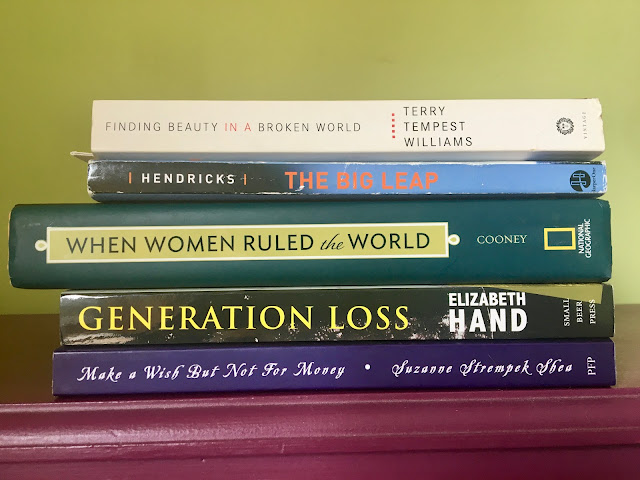
I usually read everything by Terry Tempest Williams as soon as it comes out, but Finding Beauty in a Broken World was published in 2008, when I was elbow-deep in mothering little kids and not in the right frame of mind for a book that I knew was largely about the aftermath Rwandan genocide. I picked up a copy at a used bookstore sometime in the last year or two (one that had been signed by the author!), and when I started getting delving into mosaics I decided to pick it up at last. The book begins with Williams taking a traditional mosaic workshop in Ravenna, Italy. From there it travels to a prairie dog colony in Utah and then to a survivors' village in Rwanda. I won't be able to explain well how these disparate elements are connected, but there's the metaphor of creating beautiful art from shattered pieces runs through the book, and in the village in Rwanda, Williams participates in a project of building a memorial that is covered in mosaic designs. There's also the ecological concept of a mosaic landscape, where different natural communities are patched together, creating varied and heterogenous habitats. There's also the basic inhumanity and barbarism required to both extirpate an entire species (or several species), like the prairie dog out of irrational animus, and how that is amplified in the extermination of a whole class of people (as in genocide). It is a heavy book, I'm not going to lie, but it's a beautiful one, as all of Williams' books are.

In a totally different vein, The Big Leap by Gay Hendricks was a required read for the book coaching training that I've been dragging out to a ridiculous degree. I really resonated with the initial idea that Hendricks puts forth, that we humans are uncomfortable with good feelings (out of a history of waiting for the next shoe to drop, or the next saber-toothed tiger to eat us), and so we sabotage ourselves with worry, deflecting, picking fights, etc. This gets in the way of our leveling up to our best selves (which Hendricks hyperbolically calls our Zone of Genius). So I've been working on letting myself feel good when things are going well. The rest of the book kind of proves the point put forth by the If Books Could Kill podcast, that most self-help books are mostly filler and fluff. There's a section on "Einstein time," which has something to do with thinking of time as elastic by not worrying or complaining about it anymore, and suddenly you'll have all the time you need...or something. He then contradicts this whole perspective with an anecdote about firing an employee who was late for picking him up at the airport (I mean, she was just on Einstein time, right? Also, why wouldn't you call a cab instead of expecting an employee to pick you up?). But still I'd say the book was worth the short time it took to read it for the change of mindset it engendered around allowing myself to feel good about things going well.

Finally, I finished reading a book I started about two or three years ago, having borrowed it from a friend, and stopped about 2/3 of the way through: When Women Ruled the World by Kara Cooney. It's about six women "rulers" of Egypt, over its whole long history. I'd thought, from the title, that it would be an empowering read, but as it turns out, these women who rose to prominence, either as regents for their sons or other young relatives or as women pharaohs (like Hatshepsut), were only able to obtain their power through strictures established by men and their personal power did not translate to more power for women generally. Also, there were only six of them over nearly 3,000 years. I realize it's kind of a "well, duh" to note that women who rise to heights of power are as vested in and obligated to uphold the patriarchy as the men who precede and succeed them. But reading about one after another of these women was a little discouraging (like watching an episode of The Crown, where, yeah, sure Elizabeth is queen, but everything she does is tightly controlled by a roomful of old white men with gray hair). So I got discouraged and quit, but I finally picked it up and was a little bolstered at the end by Cleopatra's story, which I didn't know much about. Yeah, sure she and her children died tragically in the end, but she was a bad*ss, and she managed to insinuate herself into the head of Egypt and manipulated both Julius Caesar and Mark Antony to hold Rome at bay (and it was those men's hubris, and their rivalry with other Roman leaders that brought them, and eventually her, down). And, of course, she was maligned by everyone ever since for daring to be a powerful woman (does anything every change?).

Fiction
For fiction I read two books I picked up last time I visited my MFA alma mater, both written by faculty of the program. 

First up, Generation Loss by Elizabeth Hand, a mystery that takes place on an island in Maine, with the heroine, Cass Neary, a former photographer who's hit rock bottom and is sent to Maine to interview a recluse photographer, where she runs into all kinds of trouble--missing children, weird artwork, suspicious locals. It's a lot darker than the mysteries I usually read, but it was fun and entertaining and creepy.

Second, I read Make a Wish But Not for Money by one of my favorite mentors, Suzanne Strempek Shea. It's about a woman who loses her job in a bank during one of our recent recessions and takes up palm reading in a burnt-out mall, discovering she has a special--metaphysical--talent for it. Her palm readings begin to bring the mall back to life, which in turn causes its own cascade of problems. It's a fun, humorous, and heart-ful take on love, friendship, and the socio-economics of the mall effect on Main Street.

Friday, April 21, 2023

Finish It Friday ~ Mosaic Shelf

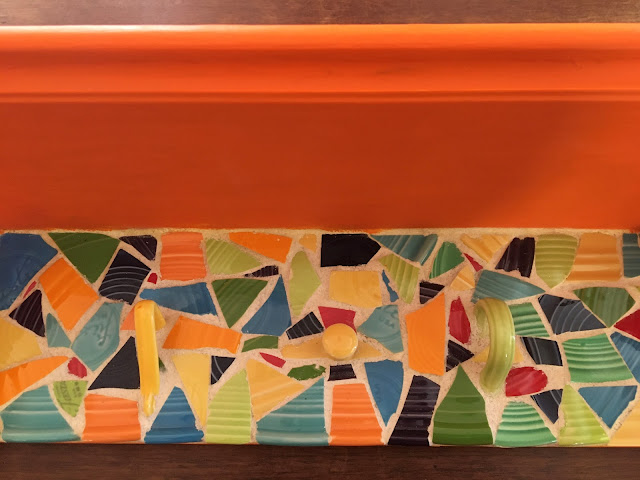
It is very strange that I have never blogged about my obsession with Fiesta ware dishes before, although they have made some appearances in the blog (notably in these posts: Kitchen Refresh, Getting the Plastic Out, and La Cocina en mi Casa). In any case, suffice it to say I have a pretty big obsession with Fiesta and a pretty big collection thereof. And, since I live with a clumsy man and three kids, I also have a pretty big collection of broken dishes, every one of which I've saved over the last 20 years for "someday" making a mosaic.

So when my friend Barbara set up a mosaic-making workshop with an artist friend of hers, I got out all my sad, broken dishes, sorted them by color, and gave them a bath.


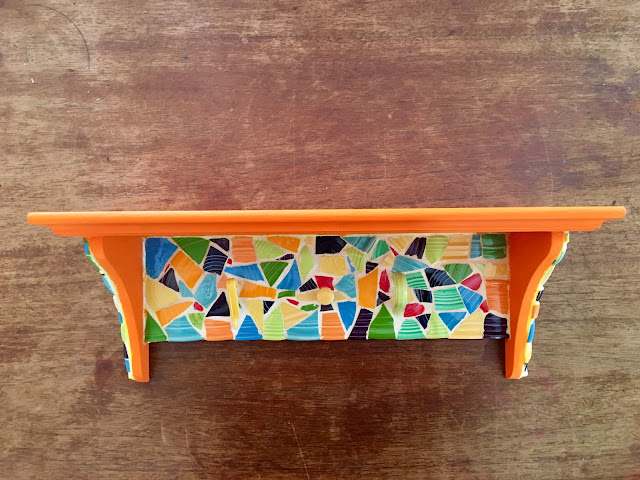
Then I turned to Kaffe Fasset's book Mosaics for inspiration. The book includes a wall shelf project, and I just happened to have this sweet little wall shelf that used to hang in the kids' room, where it used to hold the antique toys C inherited from his grandfather. It was long ago evicted from the room and had been languishing in the basement.


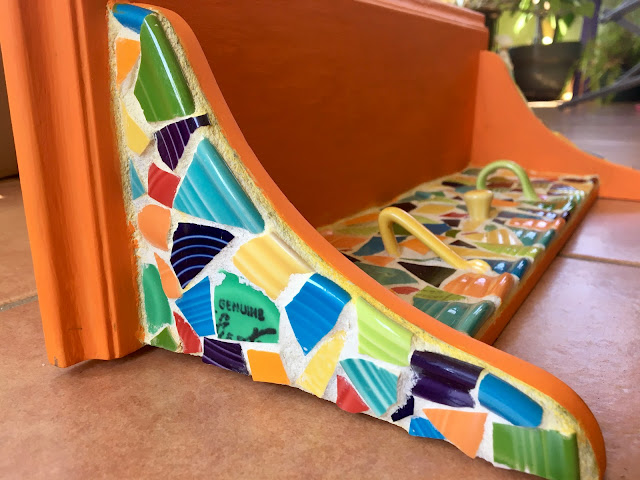
To prepare it for mosaic, I first vandalized it by scoring the surfaces I was going to stick the tesserae (that's the fancy word for little tiles for mosaic; another fancy phrase I learned is pique asiette, which means mosaics made from items like broken dishes) to and then I painted it a nice, bright tangerine color with several coats of chalk paint. Then the fun began.


At my friend's mosaic gathering, I stuck shards (most of which I'd previously broken up) into mortar on the back panel of the shelf, with a butter dish finial and teacup handles for hooks. This mortaring part is what had held me back from trying mosaic on my own all these years, but it turned out to be incredibly easy. A lesson there.


At home later that week, I mortared pieces onto the outside panels of the shelf and then, later, grouted it all and touched up and waxed the painted surfaces. 


And now I just need to figure out where to hang it up--and what to mosaic next!

Related Posts Plugin for WordPress, Blogger...