Showing posts with label nature journaling. Show all posts

Wednesday, July 28, 2021

Upcoming Workshops ~ Story Mapping

It's been a long while since I last gave a nature journaling workshop (thanks, pandemic), but now I've got two coming up, one in August and one in September, bot on the theme of story mapping.

A story map is a visual representation of a journey that may include:

  • a map depicting the route followed (which may be highly stylized and need not be to scale)
  • locations on the map where interesting things were sighted or took place
  • illustrations of scenery, flora and fauna seen along the way, and companions, among other things
  • lists of birds, wildflowers, or other elements of nature
  • anything else the story cartographer wants to use
Story maps can be made both while on the journey or after the fact.

Last summer, when all of my adventures took place close to home, I had a lot of fun making story maps of  kayak trips on local ponds and lakes. Mapping these trips deepened both my observation skills and my enjoyment while on the water. Even though I may not remember a lot about any of these trips, I only have to look at my maps and all of the details come flooding back to me.


I'm super excited to share this journaling technique with two groups this summer and fall.

The first workshop will take place on Saturday, August 7, at Hidden Valley Nature Center in Jefferson from 1-4 p.m. We'll be walking the Crossbill Loop and journaling as we go. Register here.

The second will be part of the Nature Journaling in Acadia conference that will be held at the Schoodic Institute September 19-21, a three-day extravaganza of nature journaling workshops and activities that is going to be positively amazing. Register here.

I'd love to see you at one of these workshops!


Wednesday, October 16, 2019

Wild Wednesday ~ Playing With Words in Nature

Today I got to spend a lovely couple of hours outdoors with a group of high school creative writing students. We practiced using all of our senses to describe a place, wrote a praise poem about a small natural object we collected, and then we took a walk along a poetry trail created by our wonderfully talented and energetic hostess, who happens to be the students' teacher. She's made beautifully decorated pieces of wood painted with lines from the Mary Oliver poem "Sleeping in the Forest" were mounted to trees along our way, and I gave the students the assignment of choosing a line that spoke to them and using it as a jumping-off point for free writing.


The line that struck me was "pockets full of lichens and seeds" and went a little fanciful with my free write:

Autumn trips across the land,
her pockets full of lichens and seeds.
She casts acorns in a game of dice—
snake eyes mean winter's on its way.
Where her toes touch down,
mushrooms spring up—pink, gold, purple, cinnabar—
peeking through their coverlet of leaves.
The mosses, though—sphagnum, cushion, club—
resist her touch, glowing emerald green
in the slanting sun.
And the tiny white pine, its wiry needles
gray-green but defiant.

That's all I had time for before we had to round the students up and herd them back to school.

Tuesday, June 11, 2019

Nature Journaling Workshop ~ Wildflowers


I'm offering a nature journaling workshop with a focus on wildflowers at Fields Pond Audubon Center in Holden, Maine on Saturday, June 29. We'll cover the basics of nature journaling and then head out into the field in search of spring blossoms, which we'll sketch, observe, and write about.

Registration information here. (I know it says the class goes for 1 week, but it's really 1 day.)

I hope you can join me!

Monday, April 22, 2019

Nature Journaling ~ Birds


I'm teachinga  Spring Nature Journaling workshop this Saturday, with a focus on birds, at Fields Pond Audubon center in Holden, Maine. I'd love for you to join me. We'll learn some basic drawing and journaling techniques and learn how to use them to help identify birds, remember field marks, catch fast-flitting birds in action, and record observations. Info here.

Thursday, October 18, 2018

Fall Nature Journaling Weekend

I had the great good fortune to be invited to teach nature journaling up in the wilds of Maine a couple of weeks ago.


There was a smallish turnout—I guess I should go into teaching how to file your taxes or some other universally desired skill, but what fun would that be?


And, to be honest, small groups are my favorite, where each person can work at his/her own pace, and we all get to know each other so well, even in the course of a few hours.


The weekend started Friday evening and went through Sunday morning—not quite three days, but enough time to luxuriate in attention, observation, detail.


We practiced the basics of observing and drawing.


We went on slow hikes, noting each thing of significance as we went along.


We closed our eyes to use our other senses, and wrote about what we noticed, felt, remembered, and wondered.


It was a pretty terrific way to spend a fall weekend in Maine.

Friday, September 21, 2018

Nature Journaling Weekend October 5-7

I'll be teaching a three-day nature journaling workshop at Little Lyford Lodge in Maine's beautiful wild woods near Greenville on October 5-7 for the Appalachian Mountain Club. If you've ever wanted to fully immerse yourself in observing, drawing, writing about, and just genearlly soaking up the natural world, this is the weekend for you, and I'd love to have you join me.

More information, including a workshop schedule, and registration here.

Friday, September 14, 2018

Seah Kayaking and Nature Journaling

The very first thing I did the first time I came to Maine was go on a five-day sea kayaking trip. I went on another a year later and took kayaks out for shorter adventures during my two years in college on the coast. I bought a used ("tupperware") boat many long years ago, but only had it out on the ocean once or twice before I had kids and my kayak became a dust- and spider-collecter. I've gone out sea kayaking maybe twice since we had kids (one of those trips is chronicled here). And I didn't know how much I missed paddling, that salty film on my skin, even lugging heavy boats over mudflats.


Then I had the great good fortune to have been invited to teach a nature journaling workshop for Northstar Adventures and I spent last Saturday paddling with a small group of people in beautiful Penobscot Bay, from Castine Harbor to a pair of islands in Brooksville.

There we explored the shore, did a variety of writing and drawing exercises, and ate a delicious lunch (some of our group even took a swim in the cold water).


It was a pretty divine day and I was so happy to be back out on salt water (and wondering why the hell we live in Maine but inland). With each workshop, freelance gig, and piece of writing sold, I feel one tiny step closer to my career goals (which I once articulated as, "Go canoeing and write about it.") Yet, as we speak, I'm sending out resumes, because the demands of three teenage kids (all of whom have stomachs, feet, and teeth, three expensive body parts), a house whose appliances and fixtures are all exactly 16 years old and therefore all meeting their demise at once, and two 20+-year-old cars mean that the necessity for "real job" is becoming unavoidable. Which means that going canoeing and writing about it will once again become a weekend/evening/lunchbreak/interstitial pursuit. I won't say I'm not sad about that.

But in the meantime, if you want to join me for a THREE DAY!!! nature journaling workshop, I'll be teaching at Little Lyford Lodge in the Greenville area for the Appalachian Mountain Club. See here for details.

Friday, August 31, 2018

Fall Nature Journaling Workshops

After a little summer break from teaching, I've got a great lineup of workshops coming up this fall, ranging from an hour to a whole weekend. There's something for everyone in the lineup. If you find yourself in Maine this autum, I hope you'll join me for a workshop!


Next Saturday, September 8, I'll be the visiting artist for an Explorations in Art: Sea Kayaking and Nature Journaling adventure out of Castine, Maine. (I know the course description says Cloe Chunn will be teaching, but I'm pinch-hitting, after something else came up for her.)

The first weekend in October, I'll be teaching a three-day Nature Journaling Workshop at Little Lyford Lodge in the Moosehead region.

And the following weekend, I'm leading a one-hour (free!) nature journaling walk at Thorncrag Nature Sanctuary in Lewiston, Maine for the Stanton Bird Club. There's nothing on their website yet, but the walk will take place on Sunday October 14 from 1-2 p.m.

Wednesday, November 8, 2017

Wild Wednesday ~ Nature Journal Recharge

A few weeks ago, our family attended a presentation by the naturalist Bernd Heinrich. After the talk, I picked up from the book sale table a copy of Heinrich's recent book collaboration with ecologist Nathan Wheelwright, The Naturalist's Notebook, which is a how-to guide for tracking nature's changes (phenology), with a five-year calendar/journal in the back.


It's a lovely, lovely book, with gold-edged pages and (my favorite) a built-in ribbon bookmark, illustrated with Heinrich's sketches and watercolors throughout.


While most of the information wasn't new to me, having read a lot of books about nature journaling and having gone through the Maine Master Naturalist program, I always appreciate a refresher and I especially liked the ideas of experimentation and citizen science presented throughout the book—ways of taking your nature experience beyond appreciation and observation.


I had been in a bit of a nature-journaling rut and just looking at Heinrich's illustrations inspired me to get out and get sketching.

The months I spent learning to use watercolor paints last winter finally paid off—this is the first time I've tried using them in a journaling format (other than a few stray and unsuccessful experiments over the years) and coincidentally, the art store changed brands of my preferred field notebook, to one with heavier pages that take the paint beautifully.


Heinrich describes his art supplies thus: "I use only number 2 pencils with erasers or Micron 01 indelible ink pens. I have eight brushes (but use no more than three) and two watercolor sets. Each set …holds 24 colors…. Most likely I received both sets as gifts when I was a teen and there is still enough paint left in both to last another lifetime…."


This inspired me to rethink my art supplies and drawing tools. Not that I have an excess of either, but I really do love trying out different media and adding to my large colored pencil collection.


So I've been experimenting with watercolor and number 2 pencil, and watercolor and colored pencils.


And I've been working on making the most of my different watercolor sets (three travel sets of various smallness, and a palette of colors squeezed from tubes), learning the different characteristics of each and figuring out how to maximize color combinations, especially with the little travel sets.

Most importantly, I've been using my journal to help me appreciate the natural world during these waning days of autumn and learn a little more about the world around me.


Friday, October 13, 2017

Nature Journaling ~ Event Mapping

An Event Map is a visual depiction of your time out exploring nature. Using words, simple drawings, and mapping symbols you recreate on paper the world around you—both elements of the landscape, like trees or mountains, and things that happen, like a visit from a chickadee or a dragonfly that zooms across your path. Usually an Event Map will trace your route through the landscape as you hike, wander, or explore, but you could also make an event map while sitting still. Event Mapping slows you down and helps you pay attention to and record little details; it gets you out of your mind and into the world that surrounds you.

I'll be teaching a workshop on Event Mapping at Viles Arboretum in Augusta on Saturday, October 28, 10 a.m. - 2 p.m. $35 members/$45 non-members. Call the Arboretum at 207-626-7989 to register.

This workshop will be a little different from my other Nature Journaling classes in that we'll spend less time indoors working on drawing techniques and more time out in the field exploring. After a brief introduction to Event Mapping and a few quick drawing skills, we'll wander the Arboretum's trails and create our own Event Maps. Through noticing and recording the sights, sounds, and moments in nature that draw our attention, we'll sharpen our observation skills and deepen our connection to the natural world.

Please bring: a journal, notebook, or blank paper and clipboard; simple drawing tools (pen or pencil with sharpener); snacks, water, and lunch; and a backpack to carry everything in. You may also bring binoculars, a hand lens, and field guides if you would like, though this workshop will be less about identifying and more about observing and experiencing. Please dress for the weather and wear sturdy shoes, a hat, and sunscreen or bug repellant if needed.

Wednesday, March 29, 2017

Upcoming Nature Journaling Workshops

If you're local and you want to learn more about nature journaling, I have a whole slate of workshops scheduled for the next year, starting in April at Viles Arboretum and Hidden Valley Nature Center. 


Viles Arboretum
At Viles Arboretum I will hold four classes over the next year Saturdays from 10 a.m. to 2 p.m., one for each season.
Spring Nature Journaling ~ Birds, April 29

Summer Nature Journaling ~ Bugs and Blooms, July 22

Fall Nature Journaling ~ Event Mappping, October 28

Winter Nature Journaling ~ Trees, January 20
The workshops are suitable for both beginners and experienced journalers. Each class will include an introduction to nature journaling during which participants will learn a variety of drawing techniques designed to help even the most reluctant artist overcome their fears. From there we'll explore a different aspect of the natural world using a variety of journaling techniques specific to the topic and the season, so that participants may come for just one session without feeling they have missed anything or enjoy all four while learning new ways to journal at each one. Choose one or register for all four. Registration fee: $35 per workshop for Arboretum members, $45 for nonmembers.

Workshop Descriptions:

Spring Nature Journaling ~ Birds! In this workshop we'll use our nature journals to learn more about the birds that populate our fields and forests. We'll employ a variety of nature journaling techniques—from field sketching to detailed drawings, note-taking to poetry-writing—that will help participants become acquainted with our feathered friends. 

Summer Nature Journaling ~ Blooms and Bugs! In this workshop we'll take to the fields to seek out, draw, and write about the season's wildflowers and insects. We'll observe dragonflies, bees, and butterflies, practice sketching moving objects, and celebrate midsummer flowers in our journals. 

Fall Nature Journaling ~ Event Mapping! In this workshop we'll learn how to create an event map—an illustrated depiction of a route we take through the landscape—while we wander the Arboretum's trails. Through noticing and recording the sights, sounds, and moments in nature that draw our attention, we'll sharpen our observation skills and deepen our connection to the natural world.

Winter Nature Journaling ~ Trees! Artists from Da Vinci to Cezanne have found inspiration in the spare, bare branches of leafless winter trees. Focusing on those trees, we'll work on several drawing techniques that will help us truly see the natural world before us, practice describing nature using all of our senses, and write our way into stories about the winter world around us.

What to bring: 
We will spend time both outdoors and inside during all four workshops, so please dress accordingly and bring sunscreen and insect repellant as needed. Bring a blank book, notebook, or journal and your preferred writing and drawing tools (pencil and pen, and colored pencils, if you have them), and something to sit on outdoors (lightweight camp chair, sit mat, extra jacket, etc.). If you have binoculars and/or a field guide to birds, please bring them to the bird workshop.

How to sign up: 
The workshops aren't on the the arboretum's website yet, but you can call the Arboretum at (207) 626-7989 to register.


Hidden Valley Nature Center (Midcoast Conservancy) I'll also be holding a summer nature journaling workshop at Hidden Valley Nature Center on Jun 17, 9:00 am - 12:00 pm.

Description:

June is an extra-special time at Hidden Valley Nature Center, when the woodland wildflowers carpet the forest floor. Join us on Saturday June 17, as we seek out, identify, draw, and write about some of the season’s blooms. We’ll start the day with an introduction to nature journaling, during which participants will learn a variety of drawing techniques designed to help even the most reluctant artist overcome their fears. Then we’ll head out into the woods in search of pink lady’s slippers, fringed polygala, creeping dogwood, pitcher plants, and other woodland beauties. We’ll sketch, make observations of, and celebrate these flowers in our journals.

If you’re a novice naturalist this class will help you start identifying flowers, with your journal as your aid. If you’re an expert botanist you’ll learn ways to record your observations and deepen your appreciation through journaling.

Please bring a blank book, notebook, or journal and your preferred writing and drawing tools (pencil, pen, colored pencils), as well as water and snacks. We will spend time both indoors and outdoors and will walk up to a mile or more in search of flowers, so please dress accordingly and consider wearing a hat, sunscreen, insect repellant, and whatever tick-proof clothing you prefer.

Register here.

I'd love to see you at any or all of these workshops!

Wednesday, January 18, 2017

Wild Wednesday ~ Moment(s) of Wonder ~ Owl and Ducks

In which I share a Moment of Wonder recorded in my nature journal over the previous week.

This week, I have two moments to share with you, because they were both pretty great and I just couldn't decide.

My niece was visiting from Boston for the weekend, and on Sunday afternoon, we'd all just returned from ice skating on the pond down the road and had settled down for a movie and butterscotch popcorn. The sun was starting to set in streaks of lemon and raspberry, and as I looked out the window at the scene, a large bird flew across my field of vision. From the size of its head, I knew it was an owl. Z spied the tree it had landed in and my niece and I pulled on boots and trekked down the driveway to see if we could get a closer look. As we neared the tree it was in, I thought I detected "ears"—or the tufts of feathers on the head that would indicate it was a great-horned owl. A little closer and it flew off, across our neighbor's field, ears fully visible. We walked partway across the field before it took off again.


This sighting was extra-cool for two reasons: We often hear great-horned owls calling around our house, but we've never seen one before; usually we see barred owls. And, every time my niece visits, we have a neat wildlife sighting. One time it was a close encounter with a porcupine, the other time it was a flying squirrel on our bird feeder. She's wildlife good luck!

The second moment happened yesterday. E and I went ice skating one last time before the snow when he got home from school yesterday. While I ooch my way in a circle around the ice as if I'm at an actual ice rink with a designated direction of travel, he scoots all over the pond and is up and down and up and down, sliding on his knees and butt as often as his skates. At one point, he was lying on his back and said, "Look up there."


A flock of 50-60 birds was flying overhead in a perfect V formation. They were totally silent, so not geese (also, they didn't appear to have long necks), and appeared completely black, so not gulls (I'm not sure if gulls practice such disciplined V-flying). Some kind of duck, I assume. Where did they come from and where were they going? And who can look at a V of flying birds and not comprehend that mutualism and cooperation are inherent traits in nature, and therefore should also be part of human society?

Wednesday, January 11, 2017

Wild Wednesday ~ Moment of Wonder ~ Winter Birds

I made my last nature journal entry on November 8. I had planned to start keeping a tally of the birds that come to our feeder, which I can see very well from the couch where I do most of my writing. But after that, I was too depressed to bother (though I have continued to fill the feeders).

I've thought now and then about taking out my journal, but I've either been too busy or too distracted, or just not in the mood. I'm not actively researching any particular topic of nature study right now, for which I would want the support and reinforcement of keeping a journal, and most of my outside time these days is spent in robotic laps up and down the driveway, trying to get those 10,000 steps.

And then the other day I remembered that Clare Walker Leslie, in her book Drawn to Nature, describes a practice she began when her mother was dying, of finding, and drawing a "daily exceptional image," which brought a moment of peace and light into her life, a connection with nature that helped assuage her grief. I took up this practice, both in sketches in my journal and an occasional wordless photo on this blog, several years ago and called it "Moment of Wonder." I've decided to return to this practice, going out into the woods daily, with my journal instead of my camera, open to what the world has to show me. Each Wednesday I'll share one of these moments with you.

Today, in my first Moment of Wonder walk of 2017, I came upon a small group of chickadees and psssshhh-ed them in. About six little black-caps swooped in to see what I was up to, along with an even smaller red-breasted nuthatch, and, tiniest of all, a quick glimpse of a golden-crowned kinglet. I love those tiny guys and it was a wonderful treat to see one, even if only for a fleeting moment. I wonder, though, if kinglets hang out with chickadees, why don't we ever see them at the feeder?

Thursday, October 6, 2016

Nature Journaling ~ The Hiking Journal

Before setting off on the Colorado Trail, I had great hopes of creating an artistic journal, something along the lines of this:

From Moonlight Chronicles by D. Price
I even brought an assortment of lightweight drawing supplies and had shipped to myself a series of thin notebooks for the task. I did fill in most of five journals, but most of it was writing…a lot of writing. Since the ultimate goal of this trip was to write a book, I journaled every day, even when I was really, really tired. On those days, my notes took the form of bullet points, put I at least got something on the page every day.


Unfortunately, there was a lot less time for drawing than I'd hoped. We hiked between eight and twelve hours most days, and then there was the setup and takedown of camp, meal preparation and cleanup (minimal though it was), and sleep. Lots of sleep.


So I didn't get a chance to sketch every day, or even most days. A couple of my journals don't have any drawings in them at all.


But when I did find the time for a quick drawing, I enjoyed it very much.


Even if the results weren't exactly spectacular.


On more than one occasion, I found myself wishing I had a whole afternoon—or day or week—to just explore a single hillside, watching birds, identifying flowers, sketching whatever stuck my fancy.


But that is not the right attitude for a long-distance hike, especially one on a schedule, shared with other people who move faster than me even when I'm not dawdling and drawing.


So I made do with a lot more words and photos than drawings.


And, when I found a tiny pocket of time, I made the most of it.

Tuesday, September 13, 2016

Journaling by the Sea

I'm teaching a nature journaling workshop for the Maine Island Trail Association this weekend:
Join MITA and Master Naturalist, Andrea Lani, for a morning of seaside nature journaling on Crow Island! 
In this workshop, we will comb the shore for interesting specimens to draw and identify, observe and sketch the gulls and other sea birds, and try our hands at replicating the view out over the water. We'll employ a variety of nature journaling techniques--from field sketching to detailed drawings, note-taking to poetry-writing--that will help participants become acquainted with or develop a deeper appreciation for our coastal inhabitants.  
This workshop will take place outdoors, though the island has a small cottage with a porch under which we can retreat in case of rain; dress for the weather and come prepared to get wet and/or muddy.  
Please bring a lunch and water, a blank book, notebook, or journal and your preferred writing and drawing tools (pencil and pen, and colored pencils, if you have them), and something to sit on (camp stool, folding chair, insulated mat, or extra jacket). If you have any field guides to coastal species, please bring those as well.  
RSVP is required. Transport to the island can be by your own craft or on a MITA skiff. If coming by your own craft, please try and arrive on Crow by 10:45am. MITA skiffs will have up to 10 seats available so email chris@mita.org if you'd like a ride from Portland's East End at 10am. MITA skiffs will return to East End by 2pm.  
Crow Island is a wild island with no bathroom facilities and visitors are required to practice Leave-No-Trace.  
I just checked MITA's Meetup page, and there are seven slots still available. I'd love to see you there!

Tuesday, June 28, 2016

CT Gear Post #3 ~ Luxuries

First, I finished the last two of five sleeping bags!!!

Almost down to the wire, but they're done!

Second, I was going to do a comprehensive gear post, with weights and details for everything, but I ran out of time and energy after two days of sorting couscous and oatmeal and granola bars into baggies and boxes. So instead I'll just tell you about the fun stuff. (If you want to hear more about gear, you can read about our tent here, our sleeping bags here and here, my clothes here, and the boys' clothes here.)

In the lightweight backpacking world, anything that is non-essential (as in, not your pack, your shelter, your sleep system, or pretty much the clothes on your back) is considered a luxury. And you're only supposed to take one luxury.

I knew from the get-go I wasn't going to be able to limit myself to just one fun thing, and I spent a lot of time pondering how to minimize my many luxuries. I bought a new camera, much smaller than my DSLR, but with a lot of features and a large light sensor. I initially thought I wouldn't take my phone, but decided I should for safety, communication with my family, who we will meet along the trail on occasion, and checking up on business (i.e., finding out if any of my pending submissions have been selected). I also downloaded some books I want to read to the kids onto it--Tom Sawyer, Treasure Island, Kidnapped to double its value. As a naturalist, I feel naked without a field guide or two in my back pocket, so I picked up a set of folding, laminated Pocket Naturalist guides, and limited myself to birds and flowers.

For my journal (which really is essential, since I'm writing a book), I settled on a series of thin, mid-sized Moleskine notebooks , a new one sent to me each week, and a set of mini colored pencils in a limited but pleasing palette. A little while ago, I started a daily habit of reading a poem each morning. I fell out of the habit recently, but decided I want to get back on track during this trip, so I picked up a book of Mary Oliver poems, and then I did something I've never done to a book before--I defaced it, cutting out the pages and divvying them among my resupply boxes. The pages are tucked in the back pocket of my journal, along with a July star chart and a book of postcard stamps. I also put my yoga routine, addresses of friends, and other things I want to keep track of in the back pages of my first journal, which are perforated and can migrate to my next journal. 

Inside the front cover of the first journal, I wrote a quote from A Lady's Life in the Rocky Mountains by Isabella Bird and a card a good friend of ours gave me, with an inspiring quote by Antoine de Saint-Exupery and a four-leaf clover. On page one I stuck a comic my mom sent.


I thought it would be fun to add more inspiring quotes to this and subsequent journals, so please leave in the comments your favorite quote about nature, wilderness, travel, walking, or anything else you think would be fun for me to read on this epic journey. The first six people who leave a quote in the comments, I will send a postcard from the trail (please message me using the email form on the right of the page with your mailing address). Thanks!

Tuesday, June 14, 2016

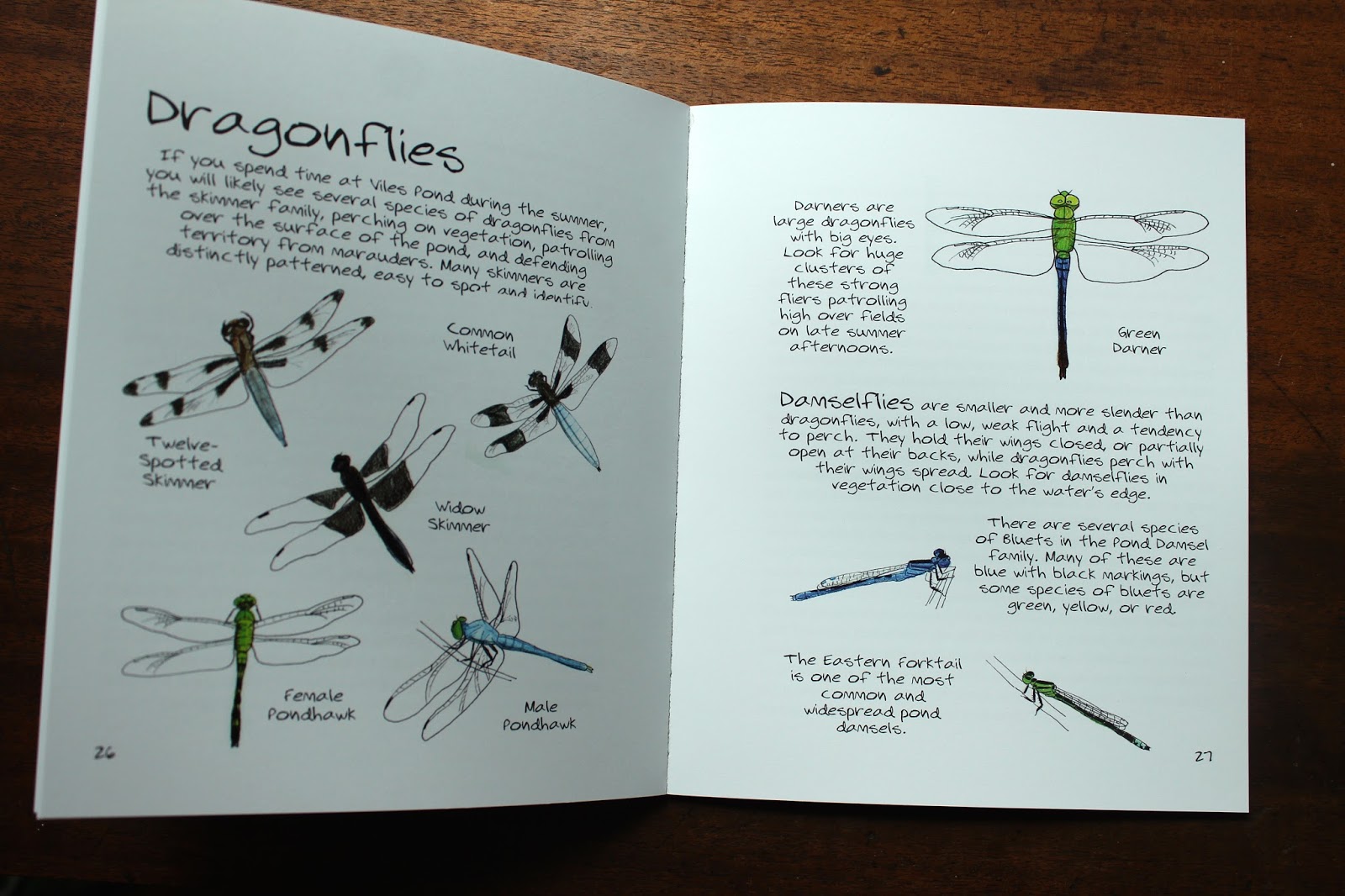
Deer Tracks and Dragonflies

I have a book!

Well, not really a book book, in that it's only been printed, not published, in the sense that there was no editor, gatekeeper, or ISBN number.

But it's got 52 pages of essays and drawings and information about the natural world at Viles Arboretum in Augusta.

 The book was the capstone project I completed during my Maine Master Naturalist training program.

For each month of the year, there is a short essay, or vignette, and a two-page spread of some aspect of nature that you can see at the Arboretum at that time of year.

My goal was to make the book both accessible to those with little or no natural history knowledge, but also interesting to those already familiar with the natural world. I'm not sure if I hit that sweet spot or not, but I had a lot of fun writing and illustrating it, and of course wandering the Arboretum for research. The books will be available in the Viles Arboretum gift shop very soon, if not already. I hope to have a reading and book signing event in the fall, about which I'll keep you posted. And if they become available for online purchase, I'll let you know that as well.
Related Posts Plugin for WordPress, Blogger...