Showing posts with label Master Naturalist. Show all posts

Thursday, December 31, 2020

I Did It! 2020 (aka Apocalypse Year 1) Edition

For the past six years, I've tracked my annual accomplishments via an annual I Did It! list, originally inspired by writer Lisa Romeo. Previous posts can be found here: 2019 (including decade-in-review), 2018, 2017, 2016, 2015, 2014, 2013. 


Let me just start this year's list by acknowledging that 2020 was a real sh*t-show of a year, and if all you managed to accomplish was doom-scrolling Twitter and binge-watching Tiger King, that's okay. I'm not here to judge or make anyone feel bad. In terms of hours devoted, streaming TV was probably my most productive activity of 2020. Nevertheless, traditions are traditions, and my tradition is to take a minute to celebrate my wins for the year, big and small.

Writing I-Did-Its!

My big win for the year is, of course, finding a publisher and signing a contract for my book. This was a four-year-plus-long process to get to this point, and I'm not going to let 2020 take that away from me.

My stats for this year:

  • Submissions: 16
  • Acceptances: 3
  • Rejections: 7
  • Withdrawals: 4
  • Radio Silence: 2
  • Publications: 4

"The Quilt" Willows Wept Review, September 2020 

"A Review of The Beginning of Everything by Andrea J. Buchanan" Literary Mama, May 2020 

"Faith in a Seed" Spire: The Maine Journal of Conservation and Sustainability, April 2020  

"Sled Dogs and Search and Rescue" Maine Wilderness Guide, Winter 2020  

As  was the case for the last few years, while I've been working on The Book, I haven't been producing as many shorter works for submission. Some day I'll have to figure out how to keep short pieces going on the side while working on longer works. 

Other writing accomplishments:
  • I re-reinvigorated my newsletter, moving to a monthly schedule and sending out 11 issues.
  • I only wrote 35 blog posts--my lowest number ever--but I didn't abandon the blog entirely.
  • I mostly finished drafting a second book and I did a fair amount of research on a third.
  • I started a novel and got pretty deep into characters and plot, but had to shelve it at the point when I needed to delve into historical research, just when all the libraries shut down for the pandemic.
  • I continued to edit for Literary Mama, both as a department editor in the Literary Reflections Department and as a Senior Editor (I suppose you could call another publication my letter from the editor in the July/August issue).
Travel and Adventure I Did Its!

Well, it wasn't much of a travel year for anyone, was it? Weeks went by in spring when I barely even left our property, let alone the county. What I did manage:
  • Several local kayak trips, including one night paddle among the bioluminescence. I had fun making journal pages for some of these trips
  • An overnight at a cottage on the beach, courtesy of a friend.
  • A November hike with my family (who are usually impossible to drag out of the house) up a mountain not too far from home.

Arts and Crafts I Did Its!

Likewise, this wasn't a very crafty year, although it seems like it should have been what with all the stay-home-ness. What I did do:

  • Made a cute little table topper thingy.
  • Made a table runner.
  • Made a billion face masks, starting with these.
  • Finished C's fair isle vest.
  • Remodeled my old dollhouse (phase 1, phase 2, phase 3).
  • I've been working on one, long, endless knitting project most of the pandemic. It's been a good TV-watching knit, since it doesn't require a lot of attention-paying, but I've fallen out of the habit the last few weeks. Time to pick it up again.
  • I did not do as much art as I would have liked, other than a little nature journaling and a couple of watercolor paintings. This is an area of my life I'd like to reinvigorate in 2021.
Household I Did Its!

2020 was the year of dealing with deferred maintenance, from repairing little things (bracelets and wind chimes that have been broken for years) to finally, finally repainting (most of) the house trim and the exterior doors. (See above. How much do you love that purple and green together?) Not that anyone other than the UPS man has seen the results, but it makes me smile every time I come home. I also:
  • Finally cleaned up and organized the basement, starting with the "jar room." Other areas that got tidied up were my arts and craft supplies, three big bins of hand-me-down clothes that are all now either in kids' drawers or at the thrift store (or waiting till spring to go to the consignment store). I would still like to do a better job of organizing the camping gear and my fabric stash (maybe either burn through or get rid of some of it), and I finally threw out stuff I was waiting for recycling opportunities to open up for--old floppy disks and vinyl bags, that sort of thing. What I'd really, really like is for C to finish off the corner of the basement where all this stuff is stored and put in better lighting and shelving so I have better space to work with. Maybe some day...
  • Expanded my Fiestaware collection...by a lot. I admit, I got a teensy bit carried away, but I'm pretty happy with my purchases (it all started with Goodwill but after the pandemic began, I turned into eBay, Replacements Ltd., and Fiesta Factory Direct for my fixes). Okay, so maybe buying stuff isn't exactly an accomplishment, but Fiestaware was invented during the Great Depression to cheer people up, so I feel like I'm carrying on that tradition--of cheering myself up with colorful dishes. All the new dishware necessitated reorganizing kitchen shelves and cabinets to create storage and display space where there was none before, so that's something
  • In this same vein, I continued on my never-ending (and vain) quest to get the house so clean it stays clean by reorganizing and decluttering various book cases, cabinets, closets, and rooms.
  • I spread topsoil and grass seed in front of our house, something we neglected to do after building, resulting in a bald, weedy lawn (don't get me wrong; I'm okay with "weeds" and even planted violets and bluets in the new lawn, but more green growing things than brown dirt was my goal).
  • And I planted a butterfly garden, where I long ago put in an herb garden and then neglected it.
Nature I Did Its!
  • I co-coordinated the Maine Master Naturalist training course for 2020, with three other terrific leaders. We pivoted and retooled with the pandemic, and were able to continue carrying out a complete and robust course using remote learning platforms, videos, do-it-yourself field trips, and socially distanced field days. The further I get from the elbow-deep, day-to-day operational logistics of this, the more I realize what an accomplishment it was. As a bonus, sitting through all of the lectures reinforced my own learning from the course (back in 2014-2015) and re-sparked my interest in several nature topics.
  • I took an online class in butterfly ID and ecology, and discovered 40+ species of butterfly on my property alone.
  • Most of my birding I did at home, yet I managed to log more checklists on eBird and more species than any previous year. I also had a couple of life birds and a few not-seen-in-a-long-time species, including two great sightings of sandhill cranes (not on my property), and I worked on my birding-while-kayaking skills. One of my big plans for 2021 is to get a lot better at birding.
  • All the kayaking reinvigorated my long-held but recently dormant interest in dragonflies, and I reacquainted myself with some of my favorite species and learned several new ones. I look forward to pursuing this more in 2021.

Not too shabby for an otherwise hellish year. Another goal for 2021 is to not try to wish time away--even pandemic time, even work time--but to appreciate each moment as it comes. I'll let you know how it goes in next year's I Did It! post.

Friday, September 4, 2020

The Most Fragrant Flowers


I've been working on two writing projects this summer—both of which involve deep dives into research, one in my own personal records, journals, and photographs, the other into two centuries of other women's writing. It's hard to feel productive while doing research, at least in that dogged American protestant work ethic way we're stuck with, when all you have to show at the end of the day is a few scribbled notes or pages marked with sticky notes. Still, it's usually engrossing work and I might not come up for air at all if it weren't for the wants and needs of my family. Apparently I'm still required to cook dinner.

Other things keeping me from turning into a dusty book mite are a couple of more community-minded projects I'm involved in. One of these is co-coordinating the 2020 training course for the Maine Master Naturalist Program, which has, like everything, gone online. This weekend we'll have our first in-person field day since February—in small groups, properly distanced, masked, and sanitized—and everyone's thrilled to finally be teaching and learning in real life. Perhaps that's the lesson of this trying year—appreciate the small things, like a walk with fellow naturalists at the arboretum, or breathing.

Another of my ongoing volunteer activities is editing at the online journal Literary Mama, where a couple of weeks ago we launched our brand-new, beautiful website. I had the honor of writing the editor's letter for the issue and of working with writer Nadia Colburn on the issue's Literary Reflections essay.

And nature, of course, continues to pull me outsdoors and outside of my researching/ writing/ editing/ zooming cocoon. Since my butterfly class ended, and most of the butterflies drifted away in the midsummer lull, I've rekindled an interest in dragonflies that I'd let wane over the last few years. The best part about them—other than their colors, variety, acrobatics, big eyes, and insect predation—is that I can watch them from my kayak.

One morning, while paddling slowly along the edge of a lake in search of dragons, I came across a flotilla of fuchsia water lilies. I immediately assumed they were invasive (a symptom of our "we can't have anything nice" society), but my field guide insists that native fragrant water-lily can sometimes come in pink. And fragrant they are, like the smell Johnson's Baby Powder aspires to be: soft, delicate, ephemeral. If you paddle through a dense enough cluster of them, the perfume will drift up at you as your boat glides over their petals.

C and I were paddling through just such a garden earlier this summer, along the edge of a bog, the sweet smell of the flowers competing with the stink of the bog mud our paddles dug up in the shallow water. My friend B tells me there's a metaphor in there—the most fragrant flowers growing from the stinkingest mud. I think I'll wait until 2020 is done having its way with us before I weigh in on whether it's true.

This post went out recently to subscribers of my newsletter, along with some bonus material. You can subscribe here.

Wednesday, March 1, 2017

Wild Wednesday ~ Lichens Tree


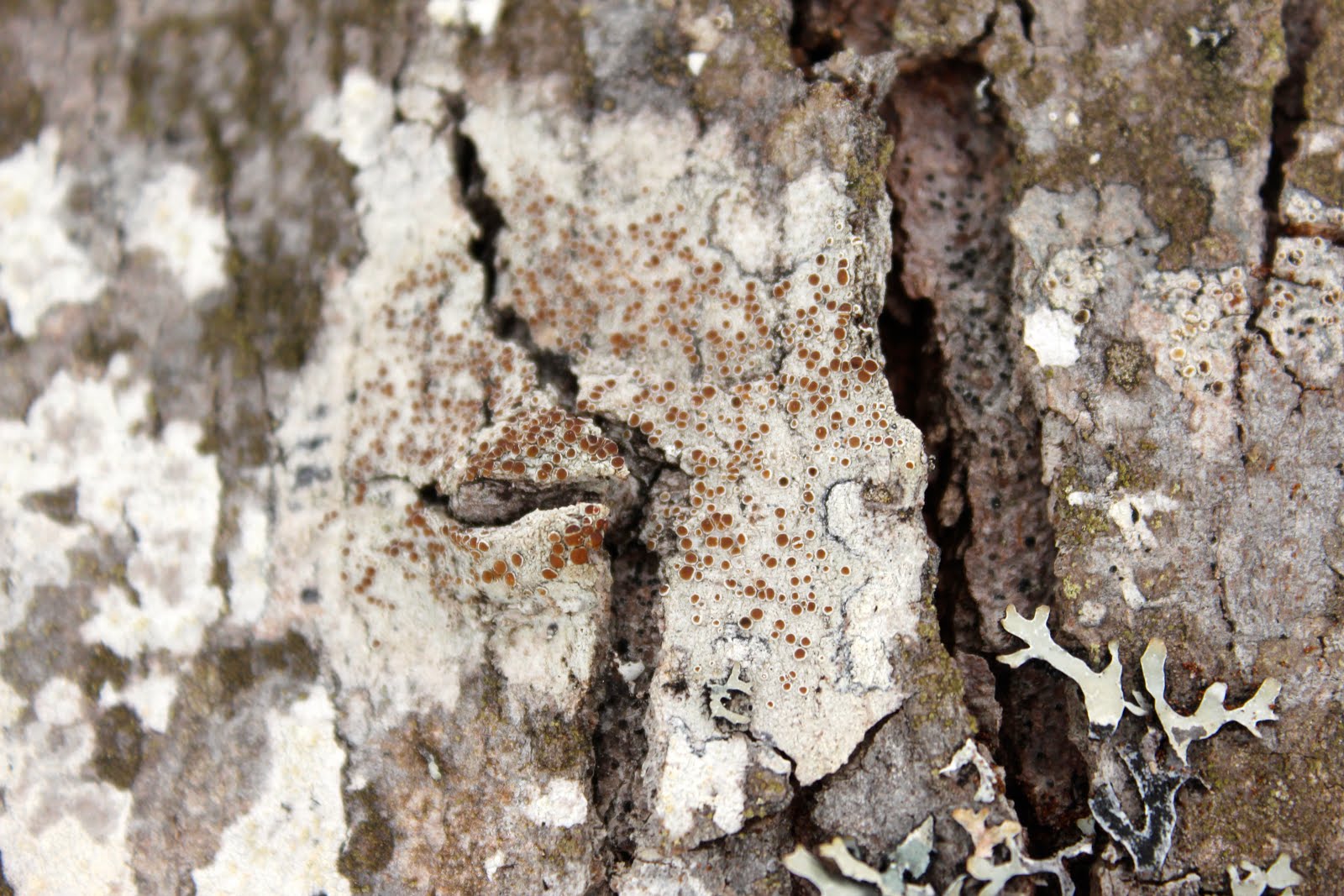
A week or so ago, I was walking in the woods and came upon this tree that appeared to be covered in every type of lichens imaginable. Lichens are organisms up of members of two or three different kingdoms. Fungi form the structure of the organism and either algae or cyanobacteria, or both, create food for the organism through photosynthesis. We just brushed over lichens in our Master Naturalist training, and to be honest, I have not pursued the subject with a great deal of vigor (I can't even find my lichens key—need to do some organizing). But I do remember that license are divided into three major groups based on their form and this tree had specimens of all three.

Crustose lichen holds tight to the surface it grows on, almost like paint; i.e. it forms a "crust" that is virtually impossible to separate from the rock or bark it attaches to.

Foliose lichen are more leafy in appearance (think "foliage"). The leafy bits are called "lobes" and they're either attached to their substrate with rhizines or, in the case of umbilicate lichen, from one central attachment point. 
Fruticose lichen grows in a shrubby, branching pattern. The shrubby part is called the "thallus" and the attachment point the "holdfast."

This tree was a festival of life. Along with the many types of lichen, it had this little patch of moss.


And this little guy, which looks like it could be a lichen, but is actually a liverwort, which is a type of nonvascular plant.


So what kind of tree was this that so bloomed in February? I must confess I almost forgot to notice (you might say I couldn't see the tree for the micro-forest). But I did remember to arch back and look up at the branches—opposite—and I snapped off a twig, just to be sure: red maple (it's hard to tell in this picture, but red maple twigs and buds are red and the buds grow opposite of each other.

As my college bio teacher used to say, "Life is so cool; it goes anywhere!"

Tuesday, June 14, 2016

Deer Tracks and Dragonflies

I have a book!

Well, not really a book book, in that it's only been printed, not published, in the sense that there was no editor, gatekeeper, or ISBN number.

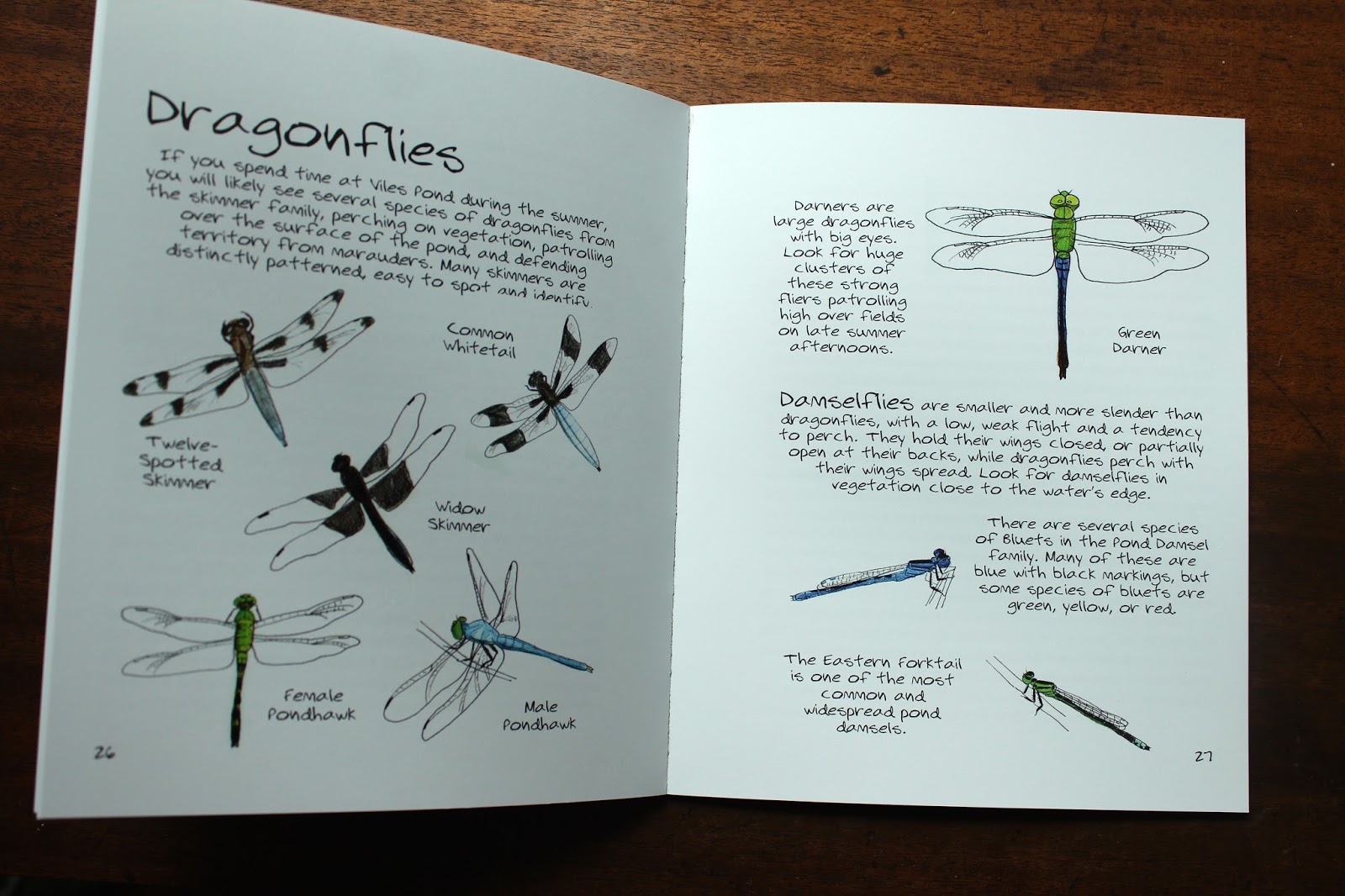
But it's got 52 pages of essays and drawings and information about the natural world at Viles Arboretum in Augusta.

 The book was the capstone project I completed during my Maine Master Naturalist training program.

For each month of the year, there is a short essay, or vignette, and a two-page spread of some aspect of nature that you can see at the Arboretum at that time of year.

My goal was to make the book both accessible to those with little or no natural history knowledge, but also interesting to those already familiar with the natural world. I'm not sure if I hit that sweet spot or not, but I had a lot of fun writing and illustrating it, and of course wandering the Arboretum for research. The books will be available in the Viles Arboretum gift shop very soon, if not already. I hope to have a reading and book signing event in the fall, about which I'll keep you posted. And if they become available for online purchase, I'll let you know that as well.

Wednesday, June 3, 2015

Wildflower Wednesday ~ June 3, 2015

I completed my Maine Master Naturalist Program training last week. It was such a great experience and I can't believe how much I've learned over the past year. I will certainly miss the people in the program and the regular structure, although it is a great relief to not face homework anytime in the near future.


I thought I'd bring a little of what I've learned--and what I will continue to learn--over to the blog with a regular post featuring wildflowers in bloom during the preceding week. Selfishly, I hope this will give me practice keying and photographing flowers (and help me remember them!)

First up, a couple of flowers of open areas, and two of my favorites. I love it when the blue-eyed grass appears in our "lawn." Something about this plant reminds me of the west and prairies. I hadn't realized there were multiple species when I photographed this guy. I'll have to go back next time I'm home in the daylight to key out exactly which one it is.

The pussytoes growing in our neighbor's field have already gone by (or been mown down), but we still have a sweet little row of them growing along the edge of our gravel pit. These I think are field pussytoes (Antennaria neglecta).

Late May into early June is the time for woodland flowers to bloom--before the trees have completely leafed out and blocked all of the sunlight. Canada-mayflower (Maianthemum canadensis) is one of the most common flowers we have growing on the forest floor.


With starflower (Lysimachia borealis) running a close second.

Feathery false Solomon's seal has just come into bloom in the last week or so. I hadn't realized it was related to Canada-mayflower until I saw the Latin name, but that makes so much sense when you look at the flowers. Edited to add: I just realized I forgot to include the Latin name, for you to see for yourself. Good thing I reread my own blog. Feathery false Solomon's seal is Maianthemum racemosum).


This is a new flower to me this year. I think it's a blunt-leaved grove-sandwort (Moehringia lateriflora).


We have a lot of violets growing on our property. I've never taken the trouble to key them out before. This one is an American dog violet (Viola labradorica).


More elusive, and so very strange and beautiful, is the Jack-in-the-pulpit (Arisaema triphyllum). One of my fellow naturalist graduates told us that she read that scientists think Jack is evolving to become a carnivorous plant, due to the long and complicated route of pollination he entices flies into. How cool is that?


I've been traipsing off-trail quite a bit in search of wildflowers and I found a nice big patch of bunchberry (Chamaepericlymenum canadense), which I didn't even know we had growing here. I've always associated it with Baxter State Park and other really wild places.


On one of my off-trail wanderings, I came across a pink lady's slipper (Cypripedium actual) hiding out in our woods. 


I've never seen one of these enchanting orchids on our land before. I stomped around the area quite a bit more, hoping to find others, to no avail. And then I took a walk on our trail and found a pair of them growing right next to the path, and then another pair, and another single orchid. Farther along the trail I found two more and in an off-trail foray, I found an eighth one.


Are the lady's slippers new migrants to our land, just appearing suddenly this year? Or have they been there all along, and we never noticed them, because our attention hasn't been on the ground at our feet (or because we avoid the woods during black fly season)? Even now that I know they are there, I still have to look closely to find them, so I can see missing them, but I'm astounded we've missed them for 13 years. And I'm delighted I finally found them. 

My main source for keying out wildflowers is Newcomb's Wildflower Guide. But because Newcomb's is out of date, I use GoBotany to cross-reference the Latin names (and also to cross-reference against photographs).

Friday, January 16, 2015

Owl Pellet Dissection

As part of my Maine Master Naturalist class homework, I had to dissect an owl pellet last weekend. I thought that this would be the one thing the boys would get into, but other than a little help from E right at the beginning, they had no interest. (Due, in no small part, I'm sure, because E and Z had a friend over and were watching a movie. And because M is a teenager: "I'm not really into owl pellets. They're kind of grody").

Yes, indeed they are kind of grody. When I've dissected pellets in the past (ones we've found in our woods and, once, one that an owl ejected onto the roof of C's car where it stayed, frozen to the metal, while he drove around for one whole day before we realized it was there), I've dissected them dry, but the directions I had said to pour boiling water over the pellet and let it sit for twenty minutes.

I was hoping this would make it easier--that the fur would float to the top and the bones sink to the bottom, but it did not quite work out that way. Instead it made it quite a bit more grody than it otherwise might have been, and I spent a good three hours picking apart teensy bones from globs of wet fir (mildly scented like moldy carpet).

I came out in the end two sets of bones (plus one extra jawbone...where had that come from?) from two voles (meadow or creeping, based on the key that came with the pellet--a barn owl's from the Pacific Northwest).


The final step in the process was to assemble the skeleton of one of the unfortunate owl snacks. I don't think I'll be hired by a museum to put together their stegosaurus skeletons anytime soon--I had run out of energy on the project and placed the toe bones and vertebrae rather willy-nilly.


But it was fascinating to see the details of the shapes and how they work--the ball and socket of the hip, the thin, wing-like shoulder-blade, the needle-thin rib bones. And pretty amazing to think how these minuscule bones correspond to the bones in our own bodies and in an elephant's and a whale's. At class this week we learned to identify the skulls of many different Maine mammals, and the similarities and differences among them left me in awe of evolution and nature. As my college biology professor used to say, "Life is so cool!"

Wednesday, December 31, 2014

Nibbling on the Elephant ~ I Did It! 2014 Edition

I've been feeling frustrated lately by my apparent lack of progress in my writing career, and I've had to remind myself that even if things are not moving as quickly as I would like, and not in as big and flashy of ways as I would like, that if I look back over the last ten years, there has been progress. Baby steps, bird by bird, one bite at a time, and all that. The annual I Did It! list (hat tip to Lisa Romeo) is a good reminder that, slow as it may be, there is progress year to year, and that progress should be celebrated.


Writing I Did Its!

Of course, my biggest I Did It! with regard to writing was graduating from my MFA program in January. As part of that graduation week, I gave a presentation on figurative language, gave a reading of some of my work, and gave one of the commencement speeches.

Since graduation, I've been submitting the fiction I worked on during the program as well as various pieces of nonfiction. My submission stats for 2014:

2014 Submissions: 40
2014 Acceptances: 7
2014 Rejections: 29
2014 Publications: 7

Among my publications for the year, two pieces were included in print magazines and one in an anthology (there's something about holding your work in your hands that is very satisfying, even if it makes it harder to share that work with your friends!). My 2014 publications:

A Place in Mind, Northern Woodlands, Winter 2014
Four Days at Russell Pond, TrailGroove, November 2014
Here Be Dragons, Motherlode: Essays on Parenthood, KY Story, October 2014
Skinny Big Hill Hard Mountain, TrailGroove, October 2014
Memento Mori, Mutha Magazine, May 2014
The Mother as She Writes, Literary Mama, May 2014
The Place Where You Live, Orion, January/February 2014

Also during 2014, I joined the editorial staff of Literary Mama, a job I am enjoying very much so far.

Finally, I passed my seven-year mark of blogging in this space, wrote 139 posts, and completed another Month of Poetry in April.

Other Life I Did Its!

It's important to have a full life in order to have a full writing life. Some of my other I Did Its! for 2014 include:

Travel: I didn't travel much last year, but I did make one trip to Western Massachusetts, stopping at Walden Pond on the way (something I've wanted to do for a long time), and another trip to New Hampshire to spend a weekend with friends. As a family, we added one day to our annual Hermit Island camping trip and we took the kids on their first backpacking trip (and my first trip in 13 years). And when my parents were here, we visited many sites and trails and beaches right here in Maine that we don't make it to very often in normal life.

Craft: Again, I don't think I was as crafty as usual this year, but I did finally, finally finish M's quilt after many years of work (and not-work). I started cutting squares for quilts for E and Z and have been learning to cable and knitting away at hats for the whole family. I crocheted a few more rocks, recovered cushions for our new couch (ahem, futon), and made a bunch of lightweight water-resistant stuff sacks for our camping trip.

Nature: I enrolled in the Maine Master Naturalist program, which began in the spring. As part of this training, I've learned how to key out wildflowers (and identified 100 of them over the summer), ferns, insects, and tree via their leaves, bark, and twigs. I've maintained a regular nature journal, plus a plant list, a bird list, and a phenology chart. I've also volunteered to help with E and Z's class during their monthly trips to a nature center. I also saw whales for the first time (for more than a glimpse) as well as a pair of otters and a swarm of honeybees. For the second year in a row, we raised and released checkerspot butterflies and are now overwintering two swallowtail pupae.

Over the next few days, I'll be thinking about goals for the coming year and how to get from here to there, but for now I'll just give myself a little thumbs up for what I managed to pull off over the last year.

Do you keep an I Did It! list? How do you celebrate your accomplishments and stay positive in the face of slow progress? 

Wednesday, September 10, 2014

Weeds

When I started my Master Naturalist class in June and was given the assignment to collect and identify forty wildflowers over the summer, I asked C if there even are forty different types of wildflowers in Maine. (His answer, a rather indignant "Yes!").


Over the next two-and-a-half months, I collected and collected and collected. Everywhere I went--beaches, hikes, strolls, parking lots, weedy edges--I looked for unfamiliar plants, snagging a representative sample and stuffing it in my bag, pocket, or car to be looked up later when I had the leisure to flip through Newcomb's and key it out. 

It's amazing how learning the names of flowers, and searching for new and different ones, has made me so much more aware of all the diversity of plant life, even in my own yard. For instance, I've known what a goldenrod is for years, but I never knew there was more than one kind of goldenrod (in fact dozens!). I never noticed the great variety in leaves, growth habits, shade of yellow and size of the flowers, and blooming time. Now I see a new species I've recently learned and it's like recognizing a friend, "Hello Slender Goldenrod, I see you're looking fine today." [Of course, there are the many flowers I learned briefly, who are more like that passing acquaintance whom I was introduced to once, but who I don't quite recognize, and whose name I don't quite remember. Is that Early Goldenrod or Canada Goldenrod? I hurry past those, not making eye contact, hoping they don't notice my rudeness.]

I passed the forty mark some time ago and kept going, finding flower number 100 right on the edge of the grass outside my office Friday morning (red sand-spurry). I don't think I'll stop there, though, but rather spend the fall sorting through the many asters and whatever last-gasp of growing season flowers come my way.

Shown above:
White snakeroot (Eupatorium rugosum)
Slender-leaved agalinus (Agalinus tenuifolia)
Large-leaved goldenrod (Solidago macrophylla)
There's also a nodding bur marigold (Bidens cernua) in the vase, but I think it's nodding so much it's out of the picture.

Tuesday, August 12, 2014

Taking a Breath

We have houseguests coming next week, so we spent most of the weekend cleaning and preparing for their arrival--


Dusting and mopping surfaces that don't usually get dusted or mopped. Sorting out weeks and months worth of toys and papers and things that tend to pile up and get ignored. I paid Z five dollars to wash my car. C even mowed the weeds lawn, which is a major endeavor and only happens one or twice a year (but I must say, it looks good!). About halfway through, consumed by dust from the kids' room, I was about ready to call our guests up and tell them to stay home. But I powered through and now we have a nice, comfy, dust-free, clean house (we'll see how long that lasts!). I even eliminated one big box of books and another box of various other junk.


Meanwhile, a beautiful, sunny weekend was going on outside. I only got out briefly Saturday, for a quick walk through the woods, throughout which I was scratched up by blackberry bushes and chased by deer flies.


Sunday evening, the bulk of the work done and an early dinner finished, I snuck out to my delimited site (the gravel pit pond by our house, which I'm supposed to observe regularly as part of my naturalist class), and settled down in a lawn chair, with a blanket to protect my legs from the bugs and my journal. Nothing too exciting was going on at the pond (no otters!), but it was nice and peaceful, with a few frogs and birds singing. Even the deer flies left me alone once I sat down. Sometimes a few moments of quiet in nature is all I need.

Monday, July 21, 2014

Weekend Things: Whirlwind

Saturday morning, I dropped M and his guitar equipment off outside of a bar in downtown Hallowell, and then wended my way through parade reroutes and bridge-out detours out of town and to a small nature preserve in Litchfield. There I joined a group of people in chasing down butterflies as part of my Master Naturalist training.

Clouded sulfur
Great spangled fritillary 

Cute beetle.

Silver-spotted skipper

Cute damselfly
When we finished, I raced back to Hallowell, where I caught the end of the second Rock Camp group's set and, happily, all of M's group's set.

Blah, Blah, Blah performing Green Day's "American Idiot"
After a quick lemonade on the waterfront, I hurried home, showered and changed, and headed back into town, where I med a friend and drove down to Brunswick for dinner and the commencement ceremonies for the students graduating this semester from my grad school program.

The whole day felt kind of disjointed--chasing butterflies, rocking out in a bar, talking writing and books, listening to inspiring speeches, dancing late into the night, catching up with good friends. It was like a microcosm of my whole life; I feel like I'm cramming too many things into too small a space. But there's not a single thing on that list I'd want to give up. Sunday I was too tired to do much of anything--we went raspberry picking, I taught E how to play Speed (in an effort to avoid playing either Chess or Pokemon) while everyone else was at C's grandmother's birthday party, and worked on my nature journal while he watched Ninjago, I made a pie. 

At the end of the day, looking around at the post-apocalyptic landscape that is our living room, I said to C, "I wish I could take a few days off work and get the house in order."

"Or," he said, "you could just stay home on the weekend."

But I don't want to stay home on the weekend...and if I do stay home on the weekend, I don't want to spend my time getting the house in order. I already feel like I have to squeeze my entire life into two days a week. I'm not giving away those two days, too.

How about you? Have you achieved this illusive "work-life balance"? And if not, what do you give up to make it all fit in?

Tuesday, July 8, 2014

Naturalist's Corners

Last week, I was tidying up my desk, to get rid of piles of junk mail and other people's stuff, and to make the surface a more inviting place to work on my Master Naturalist homework (and some writing projects I need to get motivated on!).

As I started to load my field guides and various supplies into a large grocery sack, to keep them all together, but not on the surface of the desk, I realized I needed a better system than an ugly Hannaford bag, something that would be inviting and remind me that this is work I value. So instead of the sack, I moved out a small table that had become a clutter accumulator and replaced it with this little bookcase, which had been home to wooden animals that, quite frankly (but sadly), my kids have long outgrown.

On its shelves, I placed field guides, colored pencils, dissecting kit, collecting supplies, and M's microscope. Underneath, there is just enough room for my folders and books too large for the shelves.
As soon as I finished my little Naturalist's Corner, Z made a Naturalist's Corner of his own in the sun room.


I had brought that old oak desk up from the basement last month, after we moved the houseplants outside (he had been asking me to bring it up for months!). He added the wooden crate/bookshelf, a magnifying glass, his big amethyst, jars and boxes of specimens (mostly rocks and a few butterflies found in car grilles).


He then went right to work drawing a turkey feather. Since getting my kids involved is one of my top-secret ulterior motives in becoming a Master Naturalist, I think this was a good start!


Thursday, June 26, 2014

Exciting Things in Nature, Part II

Sunday afternoon, when I got home from dropping E and Z at a friend's house, C met me at my car asking, "Did you get my message?" But my phone had died while I was at M's baseball game the night before and I hadn't bothered to bring it inside, let along plug it in to charge (I like to be left alone on the weekends--okay, all the time).

"Come check this out." He led me through the grass he had been cutting with the scythe, to our upper garden where the peas and asparagus grow, and there in a balsam fir growing next to Blueberry Tree, we beheld this:


A swarm of bees.

C, not a fan of stinging things, had noticed a lot of buzzing while he scythed and looked up to see a basketball-sized clump of bees hanging in the branches.

We wondered if they had escaped from a beekeeper nearby and if we should call someone to come get them. I remembered seeing on a nature program that bees are less aggressive when swarming. Or was it more aggressive?

Fortunately, C's phone was charged and he looked it up online and found out that:

-Bees are less aggressive when swarming, because they have no broods to protect (but if you do anything to piss them off, they'll give off the attack pheromone and you'll have 1000s of angry bees after you).

-Bees swarm very near their original hive (swarming is how colonies reproduce--the old queen leaves with a whole bunch of workers to start a new hive, leaving behind a larval or virgin queen to take over the old hive), which means we have a wild honeybee colony somewhere in our woods nearby.

-Between 20 and 50 scouts will fly out from the swarm, up to a kilometer away in search of a new hive location. When they return to the swarm, they do a dance, trying to convince the other bees of the superiority of their choice. When 80% of the scouts agree on a new site, the whole swarm will fly there and establish the new colony.

-The swarm will have moved to its new site from within a few hours to two or three days. If they don't establish a new colony in that time, they will have used up the honey they gorged on before they left and die.

Because the weather was projected to be nice as far as we could see into the future, and because we think it's really cool that we have wild bees surviving here, when so many domestic bees are in trouble, we decided to let nature take its course. C checked the swarm Monday morning, and the swarm was still there, but smaller (all huddled up to stay warm, perhaps?), but it was gone by the time he got home from work, with just a few dozen straggler bees in the area. I hope our bees found a nice, dry, ant-free hollow log somewhere not too far and are on their way to a healthy colony.
Related Posts Plugin for WordPress, Blogger...