Thursday, March 16, 2017

How to Write with (or Despite) Kids

At risk of turning this here blog into the department of shameless self-promotion, I have another publication to share with you today.

Two of my writing assistants.


In How to Write with (or Despite) Kids over at WOW! Women on Writing, I share some of the ways I've been able to make writing work for me over the years, even with three kids using up as much of my time and many of my brain cells as they possibly can. I hope you enjoy it and find some useful advice.

Tuesday, March 7, 2017

Multiples Illuminated, Part I

As they say, when it rains it pours. Or at least rains a little bit harder. I have several publications coming out over the next few months that I'll be excited to share with you as they hit the presses (or pixels as it were). Last week, my essay "No Fun" appeared on Manifest Station, in case you missed it. And then I had a guest blog post up on Multiples Illuminated.

Cunning little devils, weren't they?
It's called "Post-Twin Stress Disorder" and I don't really have to tell you what it's about, do I? It's part of a series leading up to publication of the anthology Multiples Illuminated: Life with Twins and Triplets, the Toddler to Tween Years, which will be coming out this spring, and in which my essay "Individuality, Mutuality, and a Game of Twister" will appear. (That's why this post is called Part I; Part II will appear when the book becomes available.)

If you're one of those people who's always wondered what's it like having twins anyway? or one of those people who says things like, I always wished I had twins, check out my post. It will have you running for the hills (or the birth control pills) faster than you can say "multiples."

Thursday, March 2, 2017

Slow Writing ~ No Fun

You've heard of the Slow Food movement, yes? Well, I'm a member of the Slow Writing movement. Three years ago, come April, I attended a Psychedelic Furs concert in Portland with a friend. (The poster, which I, er, liberated from a wall downtown has been hanging on the side of a bookcase ever since.)


There were several things about my experience at the show told me I had a story there, and so I started writing down my initial memories and impressions right away. After a while, though, I got bored with my writing, and felt it was going nowhere, so I set it aside.

Several months, maybe a year, later, I opened the file again and though, Hmm, maybe there is something here after all. I continued to work on the piece off and on until I finally finished and hit "submit" one month shy of two years after the concert. I'd had a place in mind to which I wanted to submit from the very beginning and I had high hopes of it getting accepted there, but I waited. And waited. And waited. After six months I sent the nudge email and got back a "thanks but no thanks" for my trouble. Over the next few months, I sent it out to seven more places, getting rejection after rejection (but at least on a faster timeline). Finally, after a total of six rejections, The Manifest Station picked it up and it appeared on their site yesterday.

A funny thing happens to writing that's been sitting around a long time—you fall out of love with it. You start to notice nitpicky problems. It no longer resonates. But, not this time around. I'm happy to report I still enjoy this piece and I'm happy to see it finally out in the world. I hope you like it, too.

Wednesday, March 1, 2017

Wild Wednesday ~ Lichens Tree


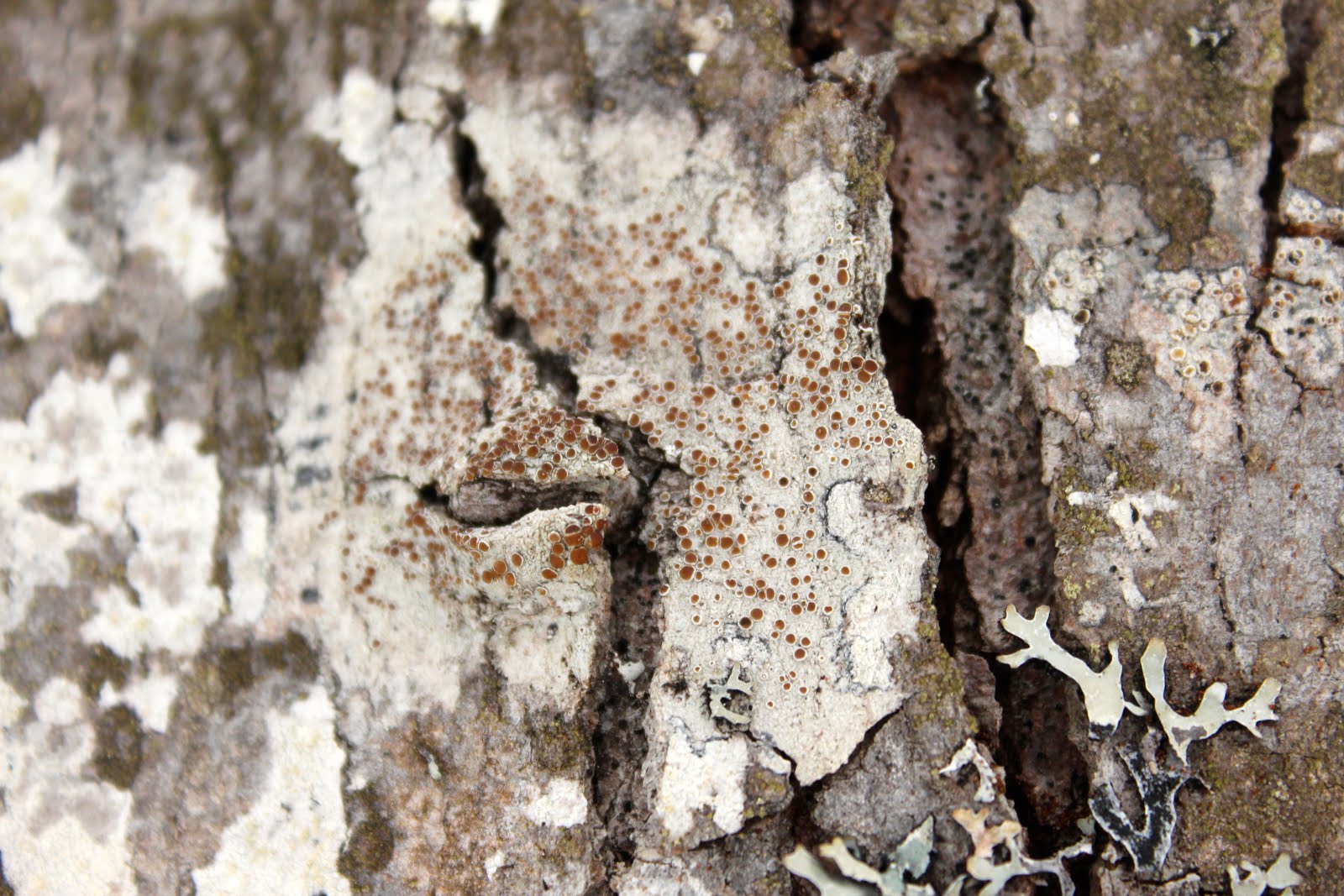
A week or so ago, I was walking in the woods and came upon this tree that appeared to be covered in every type of lichens imaginable. Lichens are organisms up of members of two or three different kingdoms. Fungi form the structure of the organism and either algae or cyanobacteria, or both, create food for the organism through photosynthesis. We just brushed over lichens in our Master Naturalist training, and to be honest, I have not pursued the subject with a great deal of vigor (I can't even find my lichens key—need to do some organizing). But I do remember that license are divided into three major groups based on their form and this tree had specimens of all three.

Crustose lichen holds tight to the surface it grows on, almost like paint; i.e. it forms a "crust" that is virtually impossible to separate from the rock or bark it attaches to.

Foliose lichen are more leafy in appearance (think "foliage"). The leafy bits are called "lobes" and they're either attached to their substrate with rhizines or, in the case of umbilicate lichen, from one central attachment point. 
Fruticose lichen grows in a shrubby, branching pattern. The shrubby part is called the "thallus" and the attachment point the "holdfast."

This tree was a festival of life. Along with the many types of lichen, it had this little patch of moss.


And this little guy, which looks like it could be a lichen, but is actually a liverwort, which is a type of nonvascular plant.


So what kind of tree was this that so bloomed in February? I must confess I almost forgot to notice (you might say I couldn't see the tree for the micro-forest). But I did remember to arch back and look up at the branches—opposite—and I snapped off a twig, just to be sure: red maple (it's hard to tell in this picture, but red maple twigs and buds are red and the buds grow opposite of each other.

As my college bio teacher used to say, "Life is so cool; it goes anywhere!"

Tuesday, February 28, 2017

February Reads

Having a single post to cover all I read in 2016 was a bit overwhelming—both to write and, I'm sure, to read. So I've decided instead to do a monthly recap of books I've read, and share a little about each book.


This month I went on a week-long reading deprivation (as part of The Artist's Way) and I read one really long, book, so my overall book count was down over January (missing from that January post, Sense and Sensibility and Harry Potter and the Cursed Child for a total of six, not counting TAW which I'm not done with yet), but that one book was so long, the page count should be fairly equal. 

First up, Harry Potter and the Cursed Child, which should have gone on January's list, but I forgot to include it. This one I read out loud to E and Z (and sometimes M). After reading to them on our hiking trip over the summer, I realized how much I missed doing that (and I think they did too), so I've been trying to keep up the tradition. This is also I know the only way to get them to experience certain books they're not inclined to read on their own. As you probably know, The Cursed Child (you have to pronounce it—curse-ed child, so it sounds like a swear word. More fun that way.) is a play, so it's a little awkward to read without dialogue tags, but we figured it out, either with different voices for each character, or I'd throw in a "Ron said" here and there to make it clear. Overall, it was a fun read, but not nearly as interesting as the seven original HP books. If Harry Potter had an after-school special, this is what it would be like. Harry's son Severus, Malfoy's son Scorpius, and a certain other person's daughter (don't want to give away too much) all have daddy issues, which all get resolved in the end. Very Hallmark channel. But with magic. So I would say, not my favorite, but still entertaining.

My poetry read for the month (at around one to five poems per day, first thing in the morning; a very nice habit to have), was Sandra Cisneros's Loose Woman. This was a gift from my blog friend Lone Star Ma a few years ago, and I only finally got around to reading it now. I love Cisneros's playful language, sly humor, and sexy stanzas. A really fun read.

Next, The Goldfinch by Donna Tartt, which I know everyone was reading like two years ago so I'm a little behind the 8-ball. One of my writing group buddies suggested we read it together, only that was months ago and she was long done by the time I got around to it. Once I did start reading, though, I flew through the first half, then got bogged down for the third quarter, then really got into the last quarter again. It was an engaging book, a little on the long side (I think 100 or 200 pages could have been cut without losing anything), with a very mystery-like story and a surprising but satisfying ending. But. But, definitely required a suspension of disbelief for all of the terrible things that happen to the main character (no on can have that much tragedy, right), which I found more unrealistic than the actually unrealistic elements. Also, it was not a relaxing read. I was pretty stressed out and on edge the whole time reading—not a good choice when the world is already putting one into existential distress. But the ending is redeeming, and the (very, very long) denouement leaves on a hopeful note. So there's that. I'm glad I read it and I'm glad it's done.

Finally, while the shitshow that is America today has sent many I know scurrying for classic dystopian reads like The Handmaid's Tale and 1984, I've headed in the opposite direction, picking up Charlotte Perkins Gilman's Herland, a utopian tale of an all-woman society. Gilman is best known for her autobiographical short story "The Yellow Wallpaper" which depicts a woman going mad from the ravages of postpartum depression and "the rest cure." In Herland, she tells the tale of three male explorers who come upon a remote and isolated country of all women. If the reader can overlook the dubious science behind the parthenogenetic reproduction that takes place in the land, and that the race of this 2000-year-old culture in South America is white, it is an engaging and entertaining read that turns every assumption the male explorer-narrator has about gender and western civilization on its head. The women of Herland are utterly and completely devoted to motherhood—recognizing the great miracle of their being able to reproduce at all—and every endeavor they undertake—from cultivating land to building cities to designing clothing—is for the betterment of their small world for the children's future, including refraining from reproducing more than the land can sustain. Theirs is not a sappy, sentimental motherhood, but rather a practical and universal one; every woman is a mother to every child. The narrator describes it thus, "You see, they were Mothers, not in our sense of helpless involuntary fecundity, forced to fill and overfill the land, every land, and then see their children suffer, sin, and die, fighting horribly with one another; but in the sense of Conscious Makers of People. Mother-love with them was not a brute passion, a mere 'instinct,' a wholly personal feeling; it was a religion." Though written in 1915, the women of Herland are subjected to attitudes from their male visitors that we still experience today, including mansplaining and rape culture. Herland continues to be relevant today and is worth a read not only for the clever, amusing story but also because it can remind the reader that there are better ways to do things than "the way it's always been done." It also teaches a very useful mode of argument—continue to ask innocent questions until your opponent is forced to concede the error of his thinking.

What are you reading this month?

Monday, February 27, 2017

Weekend Things ~ A Trip to Boston

We spent the last couple days of school vacation week in Boston, where we went to the Harvard Museum of Natural History, the New England Aquarium, visited with relatives, rode the T, and walked around the city. I left my big camera at home, but here's a few shots I captured with my phone.


It was bizarrely warm there for February—so much so we went out for ice cream. Disturbing in a the-world-is-coming-to-an-end kind of way, but pretty nice for walking around in, compared to the dreary gray, cold, slushy weather I was expec

Thursday, February 23, 2017

Documentation ~ Still So Far Behind

It's been my New Year's resolution for the last four years (at least!) to get caught up on putting all my digital photos into albums, and it's a resolution that I've failed to keep, year after year. In fact, it's been two years since I last finished an album, and I've been taking photos all that time, falling even further behind.


For several months now, I've been copying photos from past years onto a backup drive and deleting them off my computer to make space. When I hit 2012—the next year in line for album-making—I also had to upload them to Snapfish, my photo processing site of choice. This all took forever—partly because we were having problems with our internet (which the phone company eventually traced to a bad wire 3 miles from here), and partly because I had SO MANY pictures from 2012.

I could not figure it out—that was the first year I was in graduate school, while still working full time. When did I have time to take all those pictures? It then occurred to me that what I didn't have time to do was delete any pictures—there were lots of duplicates, blurry shots, and otherwise not that great photos in the mix. (I also didn't have time to edit the photos—as can be seen from those shadowy faces on the front cover).


I also got my big camera that year, which has got to account for at least some of the excess of photos. Going through these images multiple times (once to upload, once to copy onto hard drive, once to delete, once to import into the album-making thingy, twice more to import them after errors and when  I realized I'd need to be more selective or the images would be the size of postage stamps in order for them to all fit) I was astonished by how much we did that year—out-of-town guests (my parents, my sister, my niece twice), two camping trips, a weekend at camp, a trip to Boston as a family, a trip to Boston with M's class, a boat trip with E and Z's class, a gazillion trips to the beach and to various nature centers and museums and hiking trails. Crafts and art projects and holiday celebrations. It was also the year I kept a nature journal daily When did I have time to read and write all the stuff I needed to for grad school, let alone go to work and sleep? I was exhausted just looking at the pictures!


I have probably overly ambitious plans of uploading and albuming one year every two months for the  rest of 2017. I have a vague hope that there aren't quite as many photos for subsequent years as there were in 2012—maybe I got into the deleting habit. Maybe once M had his own computer (in 2015), mine would host fewer photos of Lego guys and silly videos. But I'm not entirely confident that will be the case—one thing we didn't do in 2012 was go on any big trips, which is when I really go crazy with the camera (at least I've already put my 2013 Ireland trip into an album). Stay tuned for the next installment of Andrea's Quest for Photo Stasis.
Related Posts Plugin for WordPress, Blogger...