Showing posts with label butterflies. Show all posts

Monday, August 22, 2022

Leaning into the Lull


July is lull season here in Maine. May and June's headlong rush of flowering and leafing and mating and pollinating and singing has settled into a comfortable summer's pace of more hidden fledging and seeding.

I've had the pleasure of catching some new birds shorty post-fledge: house wrens, white-breasted nuthatches, yellow-bellied sapsuckers, chipping sparrows, common yellowthroats. Our neighbor left most of his field un-mown, and in addition to giving me a front-row seat in watching the progression of grass to hay, this meant the bobolinks got a chance to raise their babies. I missed the swallows' maiden flight, though I watched the biggest baby in each nest box hog the opening (and the bugs) for two days. Bluebirds moved into one of the boxes as soon as the swallows moved out, but they're more shy, not making a spectacle of flight and feather collecting like the swallows.

As the birds wrap up their parenting duties and the flowers turn to seeds, I'm trying not to panic ("winter is coming"). After all, until this week the temperatures barely topped 80 degrees (and the nights dropped down into the 50s or low 60s, even down to 53 one night last weekend), and my trips to the beach so far have involved sweatshirts and very cold, quick dashes into the water. Which has got to mean there's a whole lot of summer left, right? 

After a big flurry of book launch events in late June, I too have hit a bit of a lull with few events scheduled for July. Which is a relief, since I lost a whole week to a tooth abscess. Though I powered through two book readings, two book signings, and four days of alumni weekend activities, most of those events bookended the worst of it, not counting one reading that took place the day of my root canal. In between, I spent a week lying on the couch watching TV all day and night (I was in too much pain to read or sleep or do anything else).

I won't say it was more painful than childbirth, but it lasted a lot longer. I've always thought the washing machine and the window screen were the most valuable of modern inventions, but now I'll throw in antibiotics and anesthesia. When I wasn't numbing my pain and brain with television shows, I thought a lot about people who lived prior to modern dentistry, especially the Ancient Puebloan people of the American Southwest, who apparently died at a relatively young age because the sand grains ground into their corn wore down their teeth. Now I know they didn't fade away from malnutrition but suffered in agony from exposed roots.

Once the pain and swelling subsided, I made it my mission to get out hiking and kayaking as much as possible. I also resumed on my morning pajama bird walks--which have grown a lot quieter of late--and daily search for butterflies. This month is, too, supposed to be a lull for butterflies. Much of the variety of last month is down, but I've seen more monarchs drifting around our property than ever before, and the pollinator garden, which I put in two summers ago, is seeing a lot of action, with six fritillaries, two skippers, and a monarch on one plant during one pass-by alone this morning. It won't win any garden club awards, the plants too close together and of crazily varying heights and colors, but the butterflies and other pollinators don't seem to care.

For what's left of this month, I'm leaning into the lull, in the vain hope that reveling in the slow pace of mid-summer can slow down time and the butterflies fluttering a little longer before it's time to face another season.

A version of this post went out recently to subscribers of my newsletter, along with some bonus material. Subscribe here and receive a free PDF of my illustrated short essay "Eleven Ways to Raise a Wild Child."

Thursday, June 3, 2021

Watching the World Unfold


So much has happened this month! The babies turned 16 and 16 and 20, which is...like...I don't even know what to think about having a 20-year-old child. I need more time to process it, like another 20 years. In the meantime, outside, the grass has grown and the trees have made leaves. Flowers have come and gone on the alders and aspens and apples. We already have buttercups and blue-eyed grass in the meadow. Does it seem like spring is happening faster than it's supposed to? Does it seem like everything is happening faster than it's supposed to? (See: babies, above.)

Right now the whole world (or at least my tiny corner of it) is that perfect shade of new green where every leaf and blade is fresh and unmarked by drought or caterpillar nibble, and I want it to stay like this forever, except that I'm as much in love with the caterpillars that nibble the leaves (excluding the brown-tailed moth caterpillars; I don't love those at all) and the warblers that nibble the caterpillars as I am with the green. The other day I was watching a dragonfly whir around my yard and I saw a Phoebe dart after it and I didn't even know which one to root for. This is why I can't watch sports; I want everyone to win--the leaves, the bugs, the birds.

In other news, a painted turtle crossed our driveway the other day, heading away from a patch of soil Curry just rototilled. I'm hoping it laid eggs (and that raccoons don't find the eggs; okay, I'll root for turtle eggs over raccoons). We have tree swallows nesting in at least three birdhouses, bluebirds (for the first time) in another, chickadees in another, and a family of phoebes under the deck. Someone is building a nest foundation of moss in yet another house, and I'm hoping it's tufted titmice. We had a nestful last year and they were the most attentive parents, bringing bugs and clearing out the fecal pellets (unlike the swallows who live in insect-infested filth), and the babies chirped so sweetly from inside the box. I came very close to seeing them fledged but missed it due to impatience. I'm hoping for a second chance.

And this week so many butterflies appeared: tiger swallowtails, azures, American coppers, common ringlets, and a possible sighting of a harvester (the only carnivorous butterfly; if that doesn't give you nightmares I don't know what will). There's simply too much going on to waste time on things like work. I'm working on a plan to reconfigure my life. It's not fleshed out yet, but whatever it eventually entails, I know I need to leave May wide open so that I have time to watch the world unfold and contemplate how old my children have become.

This post went out recently to subscribers of my newsletter, along with some bonus material. You can subscribe here.

Tuesday, May 4, 2021

April Delights


 This winter was long, longer than most, despite its relative snowlessness (another reason to read apocalypse in the tea leaves). March brought no relief. It never does. But April, despite what Eliot said, is perhaps the kindest month. Warm breezes and wild flocks migrating north, even in years when the snow hangs around until Earth Day (this year the old snow was long gone, but a new dusting sprinkled down on the 22nd). And though I'm a Leo and a summer girl through and through, April may be my second favorite month. As the world begins to wake up, so too do I, turning outward and uncurling from a winter's introspection, which always, inevitably, leads to moroseness. And so I thought I'd take stock of what's waking me up and bringing me joy this April. 

Balloons
My father-in-law is a hot air balloonist. But that does not mean he hands out rides in the basket like candy. I've been up only once, long, long ago. Earlier this month, when he was taking the balloon for its post-inspection trial flight, he took E and Z along for the ride. C and I served as chase crew, and it was like a small miracle to see our two youngest children ascend into the sky in a rainbow.

Birds
April is the month the birds return, and with no leaves on the trees and none of those pesky other b-words trying to suck my blood, it's the month for bird watching. I made a resolution to bird every day this month, and I've managed 18 so far. A first-of-year bird appears almost every time I go out. This week's new arrivals: yellow-rumped warbler, belted kingfisher, American kestrel, broad-winged hawk, and hermit thrush.

Butterflies
Yesterday I stalked a velvety chocolate-brown mourning cloak through the woods. These butterflies overwinter as adults and are always the first to appear and a sure sign of spring. I was amazed a few days earlier to see a little blue butterfly, a northern spring azure, perhaps. I chased it through the field, it flashing luminous blue upper wings while I tried to sneak up to take its picture. Now I'm aquiver with anticipation of butterfly season.

Buds
I have no doubt that social media will usher in the downfall of civil society. Nevertheless, it has its good points. For instance, I've been keeping a close eye on the flower buds of trees and shrubs in the woods around our home and snapping phone photos when the buds open and sharing them on Instagramand Facebook. It's made me much more attentive to the slow unfolding of spring, and I'm discovering that there's much about tree flowers I've never noticed, like the flowering twigs of aspen and yellow birch are high out of reach, and oak flowers, which come out after the leaves, I've never seen before.

This post went out recently to subscribers of my newsletter, along with some bonus material. You can subscribe here.

Thursday, July 30, 2020

Exquisite Litle Gems


This summer I've been taking an online field course in butterfly identification and ecology. Online and field may seem like contradicting terms, but, as with most things in the world of 2020, even nature has moved onto the internet. This format, of video chats and lectures interspersed with self-directed field work, is ideal for me this summer, when leaving home is both difficult (we are down to two vehicles for the three adults in the house, and the two of them with real jobs get dibs) and terrifying (I'm not sure which is scarier, the deadly virus or the lawn signs and flags championing the two people responsible for making the United States so virulent). When I need a break from writing or editing or housework or the inside of my own head, I grab my net, my binoculars, and my field guide and walk up the driveway to where our wild, raggedy field meets our neighbors' manicured lawn. Here on the edge, where milkweed blooms, is where I find most of my butterflies.

And find butterflies I do! Almost every day that I go out, as long as the sun is shining, I discover new-to-me species. In the six weeks of the class so far, I've identified more than 40 species of butterfly, about three-quarters of which I've never seen before, and even more of which I've never seen here on our property. How can I have missed all these exquisite little gems of creatures that have been here, sipping nectar and dancing over the flowers, for the last twenty years? It's as if my dresser drawers are full of emeralds and sapphires and rubies that I never notice because all I do is reach in and pull out socks and underwear.

I can draw two conclusions from this oversight: 1) I'm a rubbish naturalist; or 2) we don't truly see what we don't look for. There are a lot of terrible things going on in the world today—illness, death, vicious people intentionally trying to make others less safe, other people doing the same out of ignorance. I go looking for these stories every day when I read the news. But there must be other stories out there, too, the exquisite gems of courage, kindness, and generosity, if only we knew how to look.

This post went out recently to subscribers of my newsletter, along with some bonus material. You can subscribe here.

Thursday, October 17, 2019

Among the Birds and Butterflies


After a warm, dry, sunny September, October took a firm hand and reminded us all that the party's over, with gray skies, rainy days, frosty nights. Any mention of wool sweaters, warm hats, or woodstoves has me wanting to make like the woodchuck, tunnel underground, and hibernate until the sun comes out again next summer. Don't even say the words "pumpkin spice" in my hearing.

But back near the end of September, when the sky was still blue and the air not out to kill you, I got to spend a glorious day on the coast with my favorite birder. We went in search of rare birds—oddities that drop into Maine only during migration or that have veered north from their usual territories.

We saw the birds we hoped to see—American oystercatcher, royal tern, Capsian tern, and black skimmer—plus we got to observe some of the more typical shorebirds from amazingly close range. And we enjoyed a beautiful day outdoors, with no expectations or obligations.

As we moved around to different bird viewing locations, I couldn't help but notice other creatures on the wing—monarch butterflies. Wherever asters were in bloom at least two or three butterflies hovered, tanking up for their migration ahead. This abundance meshed with my observations of more monarchs this summer, both around our house and, especially, near the coast.

As we hiked along a trail that led to a point of land, we passed a native plants garden, mostly growing tall New England American asters, and there, fluttering among and dangling from the purple blossoms were more monarchs than I've ever seen in my life—dozens of them. Sharing the blooms were several painted ladies as well. Drunk on nectar, the butterflies let us walk right among them, completely undisturbed by our presence, more interested, I imagine, in imbibing the calories needed for their 3000 mile journey to Mexico. 

Just a couple of years ago, I feared I'd seen my last monarch. The caterpillars didn't appear in our fields in the numbers they had in previous summers. At least one or two years went by when I didn't see a single orange-and-black butterfly. Like all wild creatures we share the earth with, monarchs are struggling with habitat loss and fragmentation and a changing climate, and milkweed, the caterpillar's food source, has been disappearing from prime breeding areas in the Midwest thanks to pesticide use on roundup-ready crops.


I don't know what this roost of several dozen means for the future of the monarch butterfly, and I don't want to trade in false hope. But to have witnessed that big little gathering of an astonishing creature was a gift, one I hope that humanity doesn't squander.

This post went out last week to subscribers of my newsletter, along with some bonus material. You can subscribe here.

Thursday, October 12, 2017

Monarch Summers II

In late summer, my children and I search for caterpillars. The milkweed is thigh-high at this time, with fragrant mauve flower clusters swelling into rotund seed pods. When we see leaves that are missing great chunks of green flesh, we peer underneath of them, hoping to find a fat yellow-, black-, and white-striped caterpillar hiding there. When we do find one, we bring it home and place it, along with a good handful of its milkweed host, in our butterfly jar, a bulbous vase of blown glass, to complete its cycle of eating and growing and transforming into a monarch butterfly.

So begins my essay "Monarch Summers" which was published last fall in the journal Snowy Egret. JUST in case you didn't order a copy of that print-only journal, you can now read the piece at the website Nature Writing. I'd love to hear what you think.


Saturday, July 29, 2017

July Things


How can July almost be over already? Oh, summer, why do you have to be such a warp-speed time warp? I thought this would be the summer that I sat on my front porch, watching the bees pollinate the flowers, but we don't have a front porch, and I let the marigolds on my deck die from lack of water. And, well, there's been a lot of other stuff going on.


This month has been very full (I'm trying to excise the word "busy" from my vocabulary—and my mindset—and if I look at it objectively, this July hasn't been nearly as busy as in years past, when I had to go to work every day and stuff). I spent a weekend, plus one bonus evening, in the company of alumni and faculty from my MFA program, which was lovely. We talked about things like point of view and revision, publication and rejection. Things that would make people in my normal life glaze over with boredom. I imagine it's like when my husband and his building buddies get to talking about dimensional lumber and R-values.


And I had a whole entire weekend (well, just from about mid-morning Saturday to Sunday evening) all. to. my. self. And it was so amazing to be the master of my own (very, very quiet) universe. I spent a great deal of the time uploading and backing up photos, in my Sisyphean quest to open up space on my hard drive. With no one else home hogging up the bandwidth, I got a lot done. I also read. A lot. (More on this month's reading Monday.) And I only left home to pick up Saturday night's dinner and I only cooked to heat up leftovers. It was glorious.


C and M returned Sunday evening and Monday I headed up to join E and Z at their grandparents' camp. The weather had turned cool and cloudy, so after lunch, we packed up and headed to their house, where we played games and then, the next day, headed to the coast where the boys tried their hands at seine-netting (they caught a few tiny fish and some shrimp, which they had fun eating for lunch).


We've also gone swimming at various lakes and ponds, made one more trip to the beach, and raised two monarch caterpillars, which is very exciting, since it's been years since we've seen monarchs around here. I'm almost done with my 100 days of learning to paint (I'll be talking about that in my next newsletter; don't forget to sign up here). I've gotten less work done on the book than I hoped, but more than I feared. And other than book work and all that photo uploading, I've spent very little time on the computer, meaning I've ignored blogs, both mine and yours (I'm sorry). I've also rarely gotten the camera out, which you know is out of character for me. So maybe I have been watching the bees just a bit, metaphorically speaking.


We leave for vacation in a couple of days, which means it's going to be quiet around here again, but if you want, you can follow along on Instagram @andrea.lani.

What July Things have you been up to?

Tuesday, July 11, 2017

Weekend Things ~ Water

We had a quiet weekend, the last one with nothing scheduled for the foreseeable future. E and Z had a friend over Friday night and, after we'd finished the morning housecleaning (which I very meanly made them do, despite their friend's presence) I asked them what they wanted to do and the unanimous vote was to go swimming. Which I'm always happy to do.


We made our first trip of the summer to our friends' camp on a lake where we had the beach all to ourselves. I enjoyed sitting in the shade reading as much as they enjoyed swimming and dunking and being wet and the obligatory ice cream stop on the way home.


Sunday afternoon, we headed down to wade in the river, for the first time all summer.


C took underwater video.


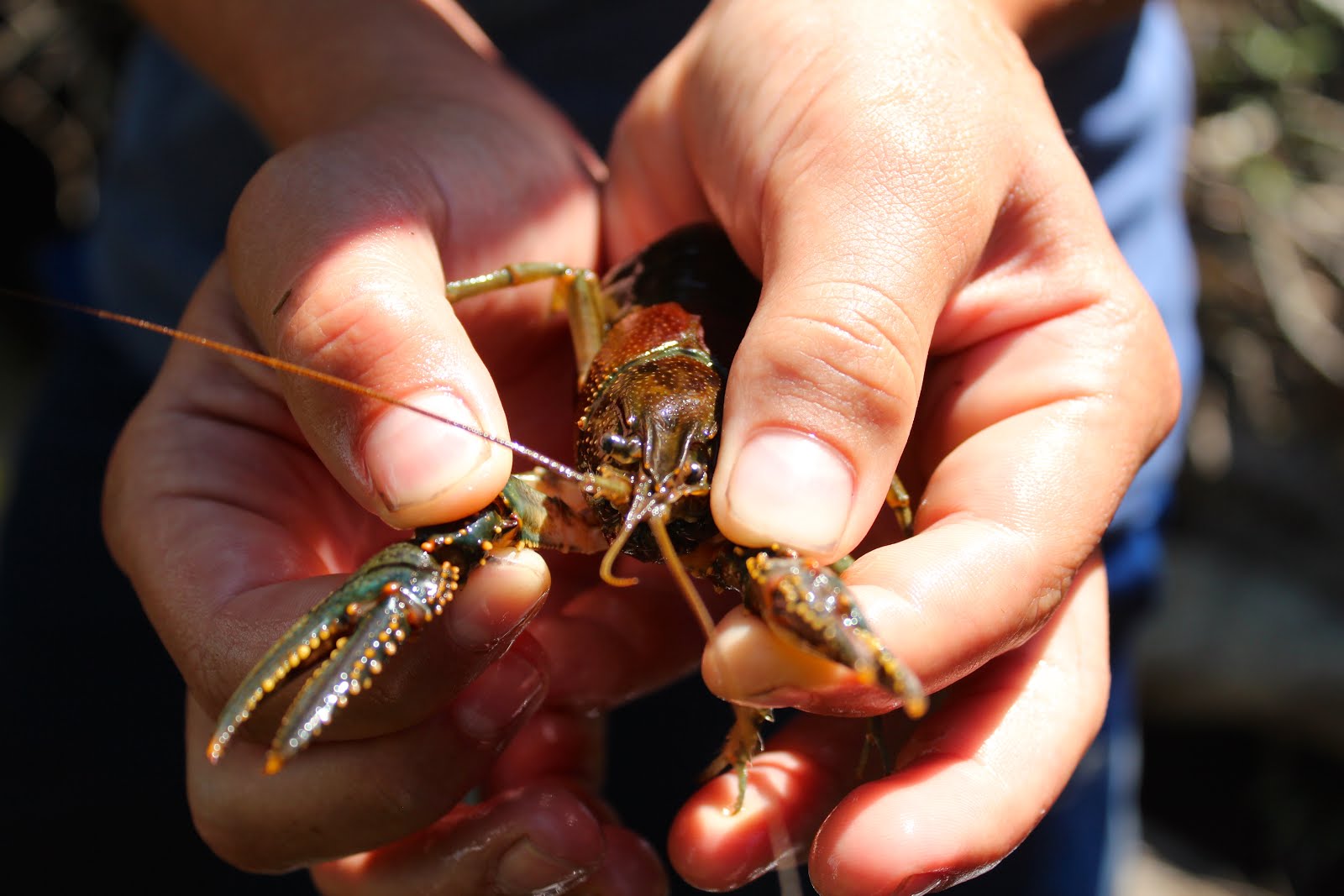
E and Z chased fish and crawdads.


And I stalked dragonflies and damselflies (more on that tomorrow).


On the way home, C and E visited one of the garden beds and discovered two monarch caterpillars on a nearby milkweed plant—the first monarchs we've found in years! We brought them in raise in our butterfly jar (they have a better chance of survival inside, away from predators). And I'm thrilled.


Three more reasons summer is the best season of all—water, dragonflies, and butterflies!

Wednesday, May 24, 2017

Wild Wednesday ~ Birds!

After getting a bit of a late start bird-watching this spring (I was still in winter-torpor mode through most of April), I went on a few walks with our local birding club and then went out in earnest around our property, heading out at least once, sometimes twice every day.

Yellow-rumped warbler
Without wishing to minimize the very real skills of my professional birding friends, I think a lot of success in bird-watching comes from being in the right place at the right time.

Rose-breasted grossbeak
And I've been very lucky that birds like our property and that I'm home to check on their activities on a daily basis.

Baltimore oriole
This least flycatcher, too, was lucky I was home yesterday when he flew into the window on our sunroom door. He lay on his back, stunned, and I brought him in the house and set up a little grass nest for him. After a couple of hours, he seemed to have recovered sufficiently and I set him on the kiwi vine on the deck. He sat their a few minutes before disappearing in the moment I looked away.


And speaking of flycatchers, while I was tending to the least, which is our smallest flycatcher, a great-crested flycatcher, which is one of our largest, arrived to claim territory in the trees around our house. It's a bird I need to relearn every spring, though I think now that I've spent an afternoon listening to him whoop and trill, I'll have it down pat.


What's wild in your neck of the woods this week?


Tuesday, May 16, 2017

Trying New Things

The 100 Day Project is a worldwide collective art project in which participants do something creative every day for 100 days and post about it on Instagram. There are no rules and what you do is completely up to you. I first heard about it sometime last year, after reading The Crossroads of Should and Must (the author, Elle Luna, is one of the organizers), but I didn't join in because I was getting ready for our big trip.

This year the project began on April 4, the exact same day I finished The Artist's Way, which was too much of a coincidence to pass up. I spent some time mulling over what kind of creative project I would want to work on every day for 100 days. I considered nature journaling, a poem-a-day, a flash fiction a day, sketchbook, and watercolor. The writing ideas didn't inspire me—I've been writing every day for a very long while and I've done a poem-a-day twice before for National Poetry Writing Month—I've also nature journaled (nearly) every day for a whole year before. I wanted to do something new and challenging and watercolor painting drew my interest more than anything else: I've always wanted to learn, but have never had the patience. This would be my chance: If I can't figure it out in 100 days (that's like 3.25 months!!), then I never will.

Still, after coming to that decision, I still had some resistance, mainly to do with the mess and the hassle of getting out paints, setting up, cleaning up. I resolved this by buying a super cheap watercolor set with lots of colors. I know it's generally preferable to use high-quality art supplies when learning, but these $5 paints helped me overcome the mess and setup issues and also made it okay to make a mess and "waste" paint, which a $75 set would tie me up in knots about.

So far it's been fun and I've learned a bit. It's also really hard. It requires patience and an understanding of how the paint behaves. I'm still in the stage of trying to control the paint. I have not graduated to the level of working with the paint to create the effects I desire. I alternate between lessons I found on some random website and just playing around with the paint. I prefer the playing around to the lessons, but I am beginning to understand why piano teachers make you learn scales before you can play songs—a solid foundation is helpful.

The picture above is in the playing around category. It's my second attempt. The first ended up a muddy mess. (When I turned the page to start again, E said, "Don't be a quitter, Mom." I showed him that I finished the first painting, but I wanted to do it again to make it better. Later he said I should get a job as a book illustrator. "I've seen some drawings in books that are way worse than yours. Or maybe you can be a butterfly painter." Aww, kids.)

Forty days in, I've hit a bit of a lull. Or maybe it's a plateau. I feel less compelled to do a painting every day (and I even missed a day this weekend!). It may be time to mix things up, get out the tube paints (or at least the slightly higher-quality travel watercolors), take a real lesson, or establish some sort of goal or theme.

Have you tried something new lately, started a new hobby, or set a creative goal for yourself?

You can see more on Instagram @andrea.lani and #100daysofandrealearningtopaint

Also see #the100dayproject and check out all the cool, crazy, and creative things people are doing.

Tuesday, June 16, 2015

Fliers ~ And One Crawler

The butterflies loved the summery weekend as much as we did.

One of our black swallowtails (Papilio polixenes) emerged. 


We collected the caterpillars from our carrot beds last fall and I hung the chrysalises under the playhouse (I was worried that if they were in the garage they might get hot and emerge early, or I might forget about them). A couple of weeks ago, I moved them to outside our front door so we wouldn't miss the appearance of the butterflies, and C saw this one not long after it came out. I'm afraid the other one is dead, though. 

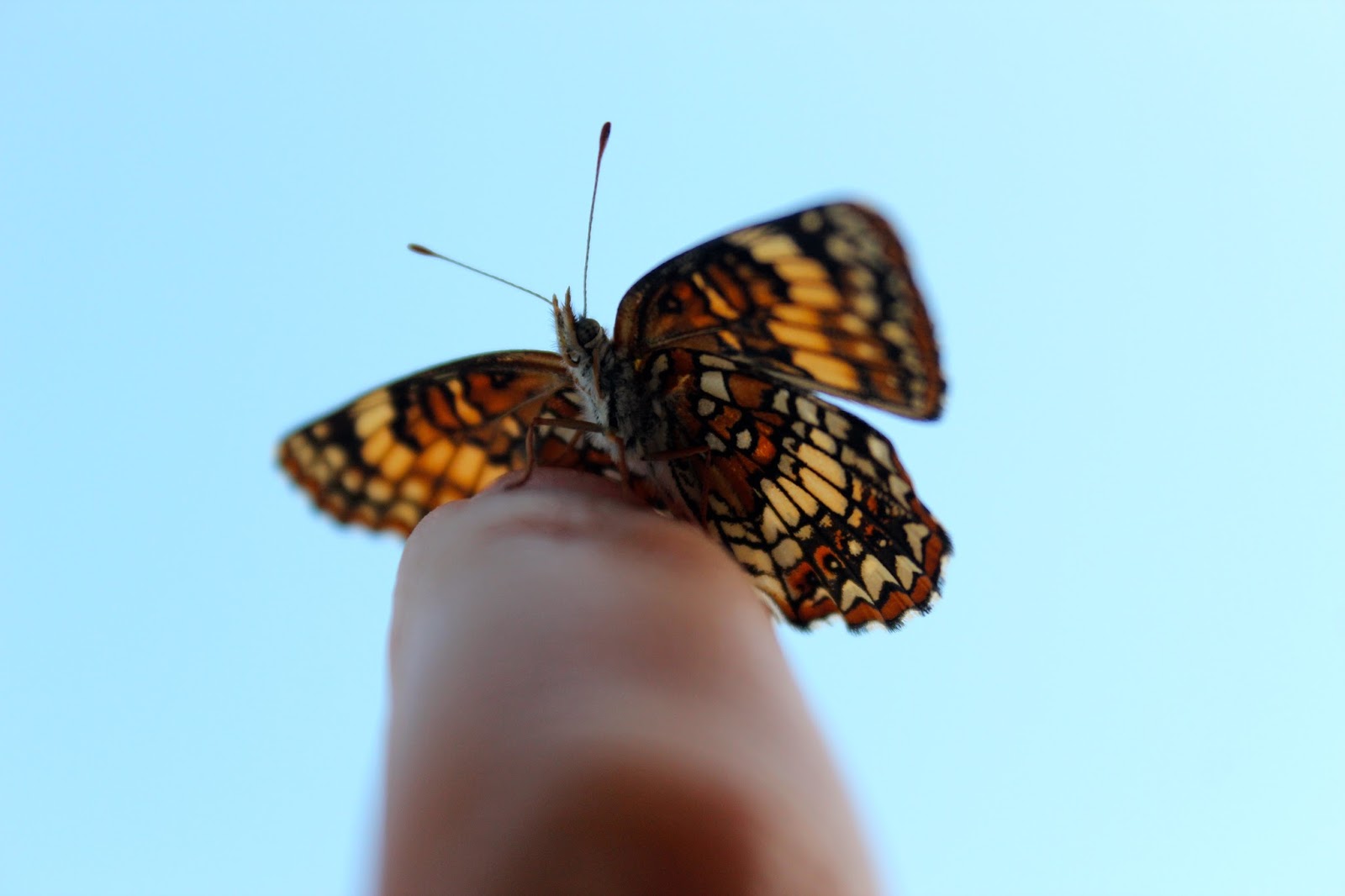
This seems to be a bumper crop for Harris's checkerspots (Chlosyne harrisii). I saw tons of the caterpillars a few weeks ago in our fields and over the weekend, there were dozens and dozens of them "puddling" on the driveway.


We've collected these caterpillars every June for the last three years or so (I thought they were early, but they were just on time with last year's butterflies). I brought home three caterpillars this year, but they escaped the jar (I didn't put the net on very well). One built a chrysalis on a nearby piece of wood, but when I went to check it, it had already emerged, but no sign of it (it has been postulated that the ducks ate it). One disappeared altogether. And one I returned to the jar where it built its chrysalis.

The gap in the netting at the top of the jar, through which the caterpillars had escaped, must have been big enough for a butterfly to slip through, too, because I found this guy on the window Sunday afternoon.
 Hanging out with the puddling checkerspots was this white admiral (Limenitis arthemis arthermis).


This is one of the most striking--and thus easy to identify--butterflies we see around here.


This tiger swallowtail (I think Canadian--Papilio canadensis) led me on a merry chase through the puckerbrush. I can see from its tattered wings (Z calls these "bird strikes") that it has good reason to be wary.


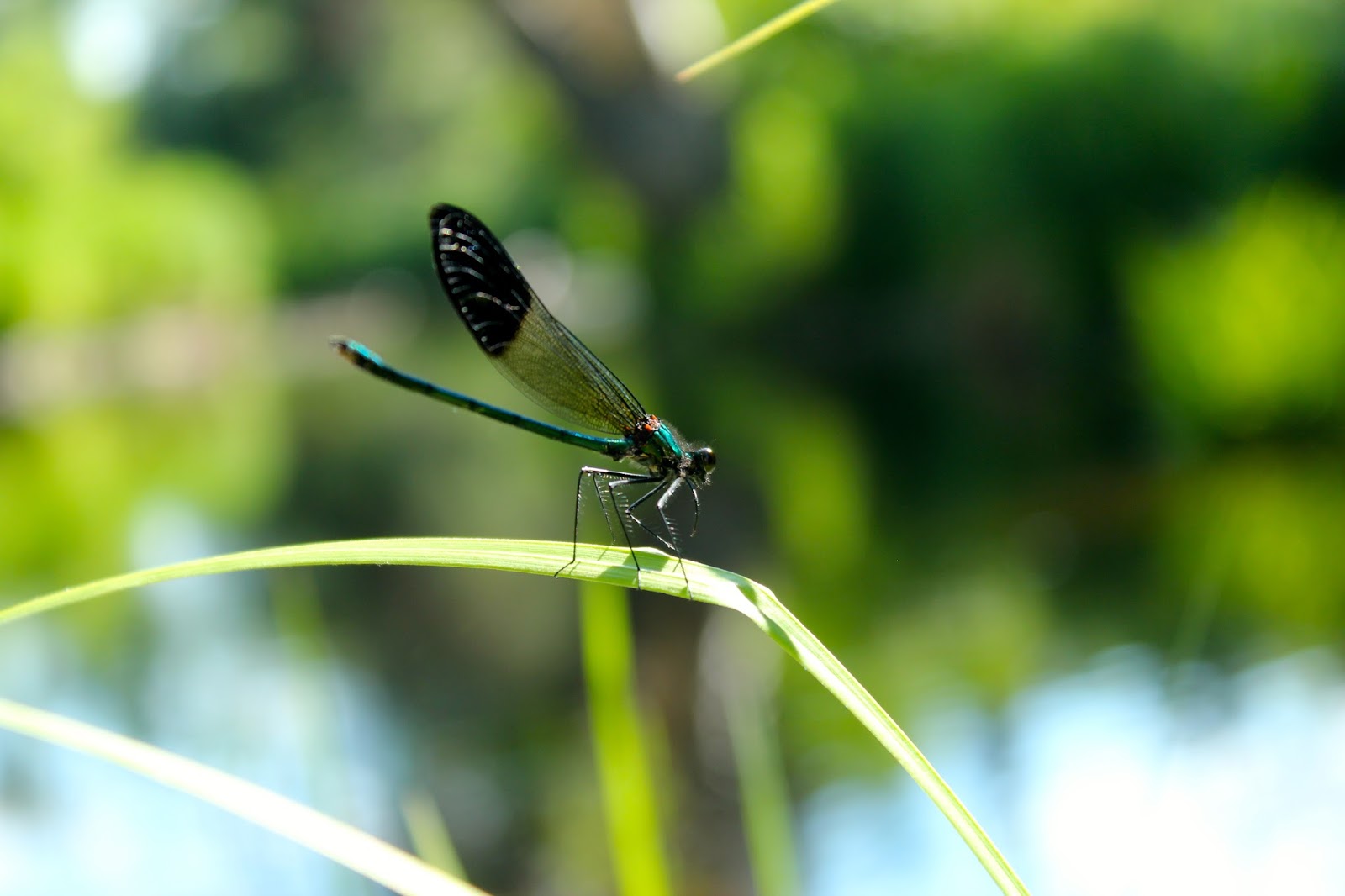
When the boys and I waded in the river, we saw two species of broad-winged damselflies: the river jewelwing (Calopteryx aequabilis

and the ebony jewelwing (Calopeteryx maculate). Seeing these metallic-green beauties flutter in the forest and you can't help but believe in fairies. 


 On one of my strolls up the driveway, I got a good look at this dragonfly, which I'm pretty sure is a basket-tailed emerald (Dorocordulia libera).


I spent some time Sunday afternoon, while the boys were at baseball practice, sitting by the pond, watching dragonflies. There were mostly dot-tailed whitefaces (Leucorrhinia intacta), which are members of the skimmer family,


and the four-spotted skimmer (Libellula quadrimaculata), a new one to me this year (here it is hanging out with a dot-tailed whiteface). Dragonflies in the skimmer family tend to perch on vegetation near water and fly low over the surface, patrolling the banks of the pond and chasing away interlopers. They're fascinating to watch.


Finally, I saw this little damselfly perching like a spreadwing, but it looks nothing like any of the spreadwings in my books. Is it just a pond damsel with its wings in an odd position? I don't know. I find damselflies even harder to puzzle out than dragonflies.

Finally, the crawler. C found this baby painted turtle in our garage on Sunday and I took him to what's left of a vernal pool near our pond (figuring it was safer than the pond with its giant snapping turtle inhabitant).

Once I let him out he skittered a short ways and then just sat there.


And sat there. He wasn't going anywhere while I was sitting nearby.


The next day, C found a turtle next that had been raided by a raccoon (we assume) during the night, right outside the garage, but what was left of the eggs looked way too small for even this tiny guy to have come out of them. So where he came from and what he was doing in the garage will remain a mystery.


 What's going on in your neck of the woods?

Thursday, September 18, 2014

Insect Love

I found myself home alone for a short while Sunday afternoon. It was too cool out to read in the hammock, and when I tried to work on a writing project in the sunroom, I kept getting distracted by dragonflies whizzing by the windows. I had just been to an all-day insect class, and I couldn't just sit there without going out to try to catch them.

Darners fly fast and high, and after chasing them for a time, catching only one Canada darner, I wandered around the yard to see what else was about. I caught a small orange and black butterfly, but didn't think of taking its picture before I let it go. And then this white admiral posed for a some pictures.

As I walked through the grass, I saw a pair of little blues mating, but when I crouched down to take their picture, they fluttered away. When I looked around to see where they had gone, I discovered they had landed on my pants leg.


I was able to take several pictures, and got a good look at the orange spots on their hind wings, the dark charcoal shade of the female's upper wing surface and the iridescent purple-blue of the male's. I even saw the faint hair-thin "tail" that gives them their name--Eastern Tailed Blue.

And still they kept at it. After a while I got a little bored and moved them to a nearby clover plant and went in to get my journal. I sketched them and wrote about them and finally, finally, they began wiggling around, grasping leaves, trying to uncouple, which took several more minutes.


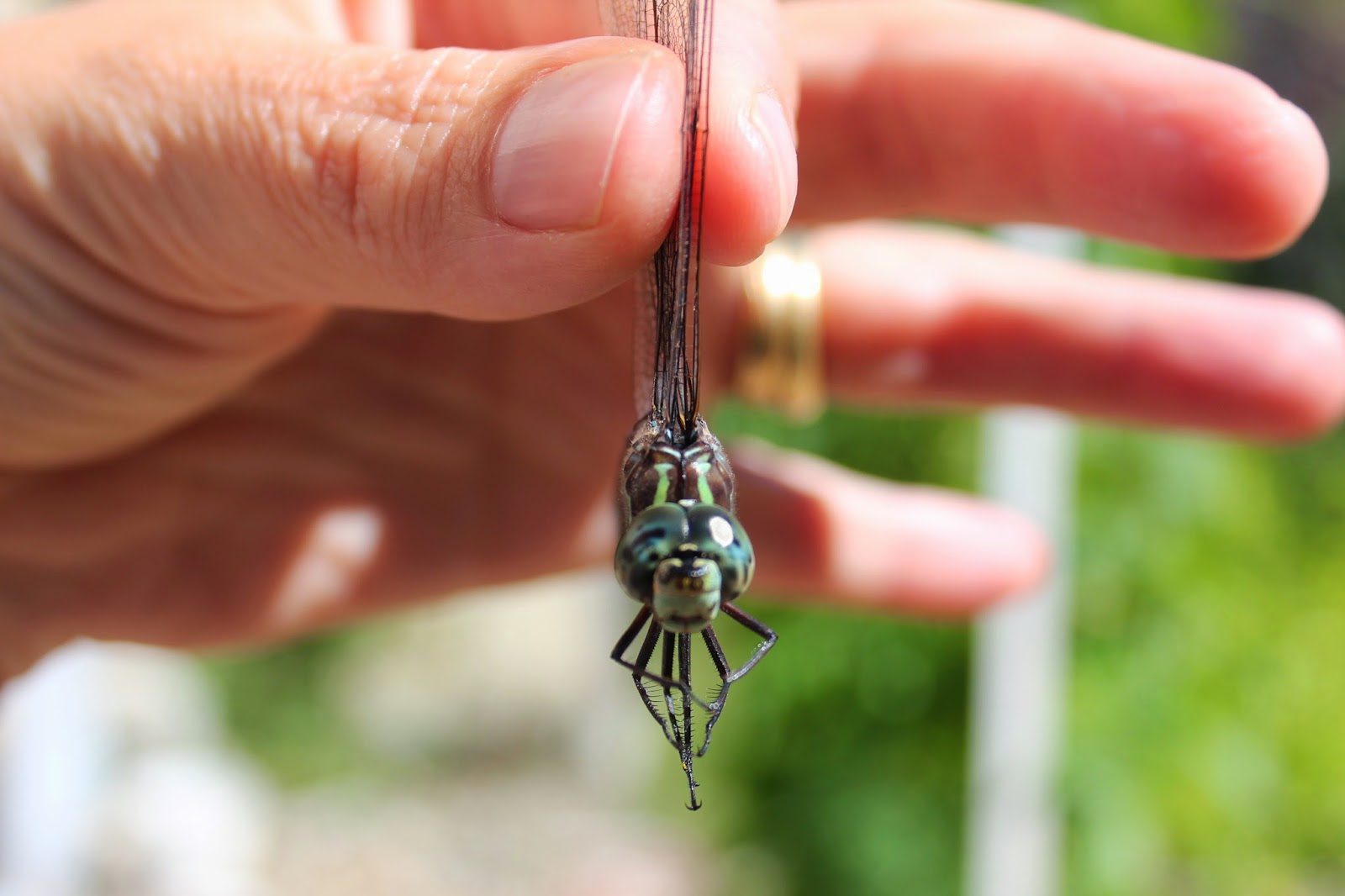
And then I caught one more dragon, this Black-Tipped Darner, before getting back to work.

Wednesday, September 17, 2014

Swallowtail Update

Our black swallowtail caterpillars have become pupa!


They have now entered their most vulnerable stage of life (teenager hood--it's tough for all species), with all of their systems, except their central nervous system, dissolved into a gel, ready to rearrange caterpillar into butterfly. But first, diapause, while it waits out the winter, pretending to be just another curled brown leaf (in contrast to the beautiful jade and gold of the monarch chrysalis).

I spoke to a butterfly expert about our caterpillars Saturday, and he suggested tying thread to those very tiny strands of silk that anchor them to the sticks, and then carefully peeling away the cremaster (the anchor point) and hanging them by the thread in an open shed. The advantage of this method would be that when the butterflies emerge (or eclose), they would be able to just fly away (and not get trapped in a jar). The disadvantage is that we would not be able to bring them inside and watch it happen. The pupa might also be more vulnerable to predators, although I'm sure my pretzel jar with lime-bag netting for a cover is not exactly mouse-proof.

I decided to just put the jar up under the rafters of our carport for now. Tying thread to those tiny strands seems like it would be tricky business. Also, I do want to see the final result next spring. We just have to remember we've got them when the snow melts and it begins to warm up outside.
Related Posts Plugin for WordPress, Blogger...