Showing posts with label wildflowers. Show all posts

Tuesday, May 4, 2021

April Delights


 This winter was long, longer than most, despite its relative snowlessness (another reason to read apocalypse in the tea leaves). March brought no relief. It never does. But April, despite what Eliot said, is perhaps the kindest month. Warm breezes and wild flocks migrating north, even in years when the snow hangs around until Earth Day (this year the old snow was long gone, but a new dusting sprinkled down on the 22nd). And though I'm a Leo and a summer girl through and through, April may be my second favorite month. As the world begins to wake up, so too do I, turning outward and uncurling from a winter's introspection, which always, inevitably, leads to moroseness. And so I thought I'd take stock of what's waking me up and bringing me joy this April. 

Balloons
My father-in-law is a hot air balloonist. But that does not mean he hands out rides in the basket like candy. I've been up only once, long, long ago. Earlier this month, when he was taking the balloon for its post-inspection trial flight, he took E and Z along for the ride. C and I served as chase crew, and it was like a small miracle to see our two youngest children ascend into the sky in a rainbow.

Birds
April is the month the birds return, and with no leaves on the trees and none of those pesky other b-words trying to suck my blood, it's the month for bird watching. I made a resolution to bird every day this month, and I've managed 18 so far. A first-of-year bird appears almost every time I go out. This week's new arrivals: yellow-rumped warbler, belted kingfisher, American kestrel, broad-winged hawk, and hermit thrush.

Butterflies
Yesterday I stalked a velvety chocolate-brown mourning cloak through the woods. These butterflies overwinter as adults and are always the first to appear and a sure sign of spring. I was amazed a few days earlier to see a little blue butterfly, a northern spring azure, perhaps. I chased it through the field, it flashing luminous blue upper wings while I tried to sneak up to take its picture. Now I'm aquiver with anticipation of butterfly season.

Buds
I have no doubt that social media will usher in the downfall of civil society. Nevertheless, it has its good points. For instance, I've been keeping a close eye on the flower buds of trees and shrubs in the woods around our home and snapping phone photos when the buds open and sharing them on Instagramand Facebook. It's made me much more attentive to the slow unfolding of spring, and I'm discovering that there's much about tree flowers I've never noticed, like the flowering twigs of aspen and yellow birch are high out of reach, and oak flowers, which come out after the leaves, I've never seen before.

This post went out recently to subscribers of my newsletter, along with some bonus material. You can subscribe here.

Friday, September 4, 2020

The Most Fragrant Flowers


I've been working on two writing projects this summer—both of which involve deep dives into research, one in my own personal records, journals, and photographs, the other into two centuries of other women's writing. It's hard to feel productive while doing research, at least in that dogged American protestant work ethic way we're stuck with, when all you have to show at the end of the day is a few scribbled notes or pages marked with sticky notes. Still, it's usually engrossing work and I might not come up for air at all if it weren't for the wants and needs of my family. Apparently I'm still required to cook dinner.

Other things keeping me from turning into a dusty book mite are a couple of more community-minded projects I'm involved in. One of these is co-coordinating the 2020 training course for the Maine Master Naturalist Program, which has, like everything, gone online. This weekend we'll have our first in-person field day since February—in small groups, properly distanced, masked, and sanitized—and everyone's thrilled to finally be teaching and learning in real life. Perhaps that's the lesson of this trying year—appreciate the small things, like a walk with fellow naturalists at the arboretum, or breathing.

Another of my ongoing volunteer activities is editing at the online journal Literary Mama, where a couple of weeks ago we launched our brand-new, beautiful website. I had the honor of writing the editor's letter for the issue and of working with writer Nadia Colburn on the issue's Literary Reflections essay.

And nature, of course, continues to pull me outsdoors and outside of my researching/ writing/ editing/ zooming cocoon. Since my butterfly class ended, and most of the butterflies drifted away in the midsummer lull, I've rekindled an interest in dragonflies that I'd let wane over the last few years. The best part about them—other than their colors, variety, acrobatics, big eyes, and insect predation—is that I can watch them from my kayak.

One morning, while paddling slowly along the edge of a lake in search of dragons, I came across a flotilla of fuchsia water lilies. I immediately assumed they were invasive (a symptom of our "we can't have anything nice" society), but my field guide insists that native fragrant water-lily can sometimes come in pink. And fragrant they are, like the smell Johnson's Baby Powder aspires to be: soft, delicate, ephemeral. If you paddle through a dense enough cluster of them, the perfume will drift up at you as your boat glides over their petals.

C and I were paddling through just such a garden earlier this summer, along the edge of a bog, the sweet smell of the flowers competing with the stink of the bog mud our paddles dug up in the shallow water. My friend B tells me there's a metaphor in there—the most fragrant flowers growing from the stinkingest mud. I think I'll wait until 2020 is done having its way with us before I weigh in on whether it's true.

This post went out recently to subscribers of my newsletter, along with some bonus material. You can subscribe here.

Tuesday, July 9, 2019

Paddle Away With Me

I slide the kayak off the roof racks and balance it on my left shoulder—it weighs less than the double stroller I heaved in and out of the back of my car for three years—and ease the boat into the water near the culvert. Bullfrogs thrum in the wetland across the road, and green frogs twang on the edges of the pond. A small painted turtle hovering in the shallows dives away at my approach, and I hope I've frightened it away from any ideas of crossing the road.

I bought this boat on a whim a few weeks ago. I was mad because I'd been made to work on the Sunday of Memorial Weekend, and the sporting goods store was having a sale. So I decided to treat my ill humor with a little retail therapy on my lunch break. Only it wasn't a whim, because for years I've thought how nice it would be to have a little kayak for exploring the ponds and bogs and swamps near my home. But I thought that if I had one kayak, I would need five, plus some enormous vehicle in which to tote both boats and family.

The boat glides through the tall rushes of the outlet channel and out into open water. Usually I like to paddle along the northern shore, nosing among the pickerel weed and lily pads and watching whirligig beetles twirl, but today I've been staring down a threatening thunderstorm, and now that the dark bank of cumulonimbus clouds has passed on, I have only half an hour before I need to hurry home, cook dinner, and drive kids to their soccer game. So I paddle straight across the pond, heading for the northern shore.

It's easy to forget, when you're a mom, that you can do things by yourself. By "can" I mean both "are cabable of" and "are allowed to." The latter makes some sense; after years in which peeing alone is a triumph, you tend consider the people you gave birth to extensions of your own body. "Whither thou goest" and all that. But the former is crazy. Motherhood is a job that requires the knowlege of a complete set of encyclopedias, the organizational skills of a NASA ground crew, the control of a drill seargant, and the patience of Mother Theresa. Yet somehow raising children makes us feel unequal to other tasks. How much of that feeling is inherent, I wonder, and how much dictated by society?

I paddle northward, into a wind that rumples the dark surface of the water, calling gelatinous core muscles into duty. This pond is only two miles from my house, and it's small, only about 22 acres in area and 18 feet at its deepest point. But there are only five houses on its shore, all on the southwest corner. With the road and the houses at my back, I might be paddling into the wilderness. The eastern shore is edged in hemlocks and, beyond, a wooded hillside. To the north stand the spindly forms of larch trees, rising from a sphagnum bog. Tree swallows perch on the bare upper branches of the larches, chittering and making forways over the pond to snap up bugs.

Sheep laurel grows dense along the boggy shore, bright with magenta blooms. Turqoise pond damsels dance along the edge between water and land. I nose my boat between two hummocks to get a closer look at a pair of alien-shaped pitcher plant flowers and notice a small pink blossom, then another and another and another. Calopogon orchids have come into bloom in the last two days.

I take photos and make a few quick sketches, but all too soon duty calls me back across the pond. I paddle straight and steady, the breeze now at my back, my abdominal muscles remembering that they once had structure. I lift the boat out of the water and onto the car, cinching it down tight, and drive home with the wind blowing through my hair.

This post went out last week to subscribers of my newsletter, along with some bonus material. You can subscribe here.

Tuesday, June 11, 2019

Nature Journaling Workshop ~ Wildflowers


I'm offering a nature journaling workshop with a focus on wildflowers at Fields Pond Audubon Center in Holden, Maine on Saturday, June 29. We'll cover the basics of nature journaling and then head out into the field in search of spring blossoms, which we'll sketch, observe, and write about.

Registration information here. (I know it says the class goes for 1 week, but it's really 1 day.)

I hope you can join me!

Wednesday, August 30, 2017

Wild Wednesday ~ One Week in Late August

Last Wednesday I went out and took some photos of late August happenings, with the full intention of writing a Wild Wednesday post, but then I got busy doing other things and it never happened. I considered a Wild Thursday or Friday post, but those days got filled up, too (oh, how glorious that school is back in session!!). Now here it is Wednesday again, and I thought I'd do a little compare and contrast from one week to the next.

Late August is goldenrod season around here, and a few species, including early goldenrod, were blooming.


Now the early goldenrod has gone by,


But several other species are coming online.


I haven't had a chance to go out with my field guide and identify  them yet (or re-identify, since I'm pretty sure I've learned them at least once or twice before).


Last week, most of the queen Anne's lace was on its way out, though a few were still blooming


By this week almost all (except for a few small ones here or there) have gone to seed.


The tall asters had come into full bloom last week,


And are still the predominant flower in the fields.


I had seen this puffball mushroom, about the size of a softball, on my morning walk up the driveway. By the time I came by again around noon, some little critter had nibbled away at it.


Over the next few days, it turned black and slimy and now this is all that's left. When you stamp on it—which is irresistible—it gives off its spores, like a cloud of purple smoke, which smells oddly of chocolate.


There were a few of these teeny tiny puffballs along the driveway as well, each about the size of a large grape, covered in a spiky white skin.


The skin dried and cracked, peeling away, leaving behind a brownish volcano that spurts little puffs of greenish-yellow spores.

One of my favorite flowers growing on our property is this sedum, called live-forever. Most of our wildflowers are white or yellow, and while I might not choose to dress in or decorate with magenta, I'm thrilled whenever it grow wild on my land.


It is, unfortunately, not so aptly named. Just a week later, and the blooms and stems have turned a rusty red.


What's wild in your neck of the woods this week?

Wednesday, June 14, 2017

Wild Wednesday ~ Small Wonders

There is so much going on in the natural world this time of year it's hard to take it all in. Birds! Flowers! Frogs! Bugs! I don't even know where to begin. Here's a smattering of small phenomena I came across the other morning. I stepped out on the front step and saw the dismembered remains of a June bug. Who perched on my porch and snacked on this beetle? My extensive research (googling "what eats june bugs?") turned up a lot of critters that dine on the grubs, but no mention of beetle-eaters. Any ideas?

The bluets (Houstonia caerulea) are still flowering here and there on the lawn. These are one of the first wildflowers to come out in spring and it's nice to see them still going strong (reigns in that "summer's going by too fast" sensation a bit).

E left his flip-flops in the driveway after we got home from camping and this nursery web spider (Pisaurina mira) thought the bottom of one was a dandy place to sun itself.

I've seen a few dragonflies here and there (more every day), but I've been stuck in bird mode—not yet in odonata mode. Time to dig out the net and the field guides and refresh my id skills. A few very cooperative specimens stopped to pose for a picture. This one I think is a stream cruiser (Didymops transversa).

I'm thinking this one is a lancet clubtail (Gomphus exilis).


And this one I'm pretty sure is delta-spotted spiketail (Cordulegaster diastatops).

And finally, Z discovered a robin's nest tucked in the kiwi vine that grows over our deck rail. Mama robin wasn't home when I poked my camera in to snap a shot, and I hope she returned soon after. It will be fun to witness little robins grow up right outside our back door.

What small wonders have you been noticing lately?

Wednesday, May 31, 2017

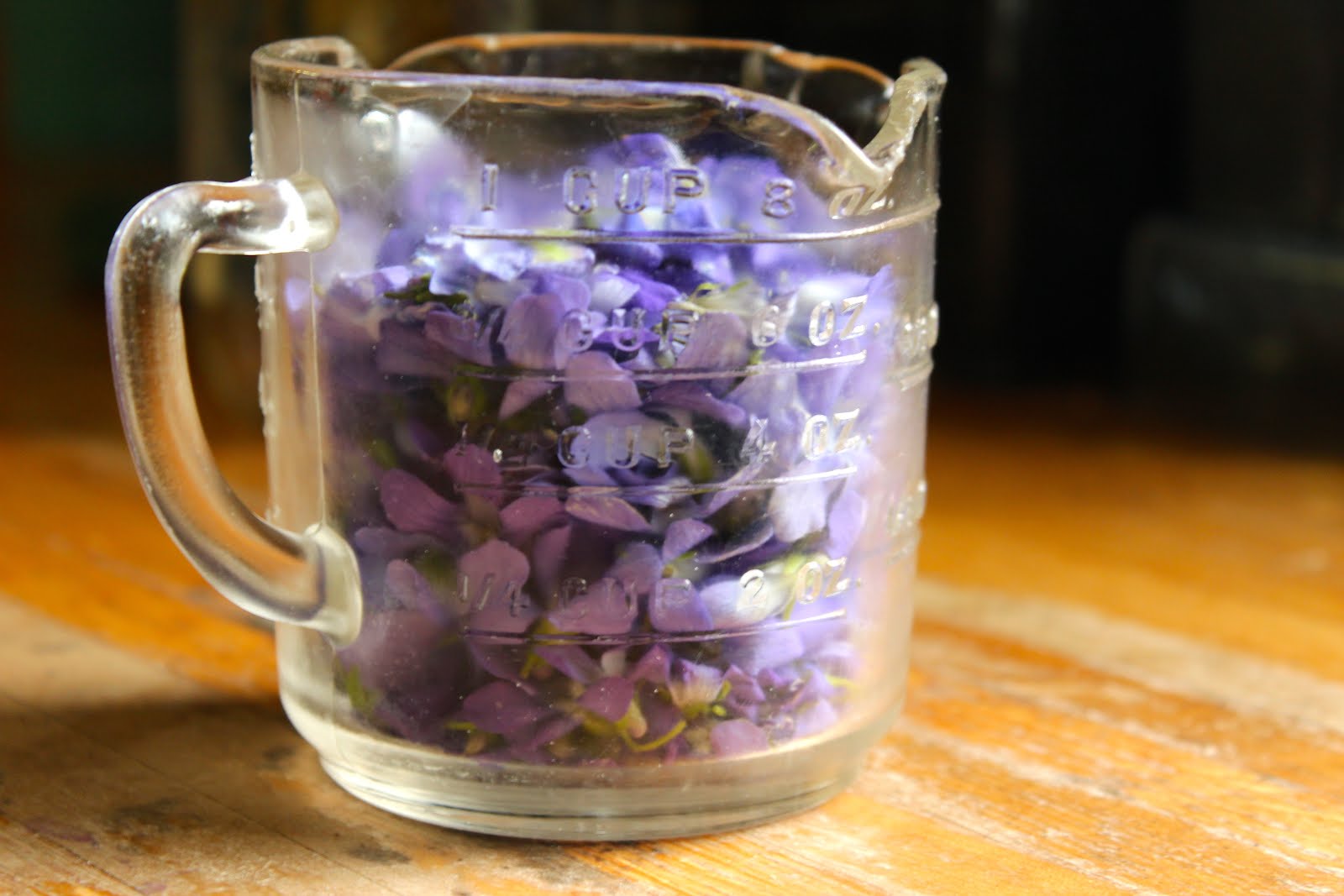
Wild Wednesday ~ Violet Jelly

Because I'm the decider around here, I'm calling this a Wild Wednesday post because violets are wild flowers. I suppose I could start another series, called Foraging Friday, but that would call for a whole 'nother level of commitment that I'm not quite prepared for.

We seem to have had a bumper crop of violets this year, and, because I've let go of most of my domestic urges, I was perfectly happy to enjoy the sign of them without feeling like I had to do anything with them. On at least a couple of occasions in the past, I've made violet jam or jelly, and on even more occasions, I've felt like I should make violet jam or jelly, but haven't had the time or energy. So it was nice to see them and smile and just be happy to live in a world covered in violets. And then the very next day, E said, "Let's make violet jam!"

Because it was his idea, I tried to get E to pick the violets, but he didn't have much stamina on a day when it was too hot for his taste (his preferred temperature range is about 64-66 degrees) and the back flies were out in force. I picked a few, but I'm no good at tedious manual labor. Finally, when I pointed out that the neighbor would soon mow his field, along with our violets, Z went on an expedition and brought back a cupful. So I scaled the recipe back by two-thirds (seriously, who is going to pick three cups of violets???).

I let the violets steep for most of a day, and they turned the water a weird and wonderful ice-blue color, which instantly changes to magenta when mixed with lemon juice.


The jelly was pretty easy to make, once the violets were picked (turns out, jelly with pectin cooks for far less time than pectin-free jam). It's also beautiful and tastes nice, but not especially like violets. C and I cam to the conclusion that all jellies are really just sugar-flavored, with the fruit (or flowers) used as a colorant.

Wednesday, May 10, 2017

Wild Wednesday ~ Serviceberry Flowering

The trees in our woods have been flowering for a while, starting with the quaking aspen back in April. But most of them, so far, have been of the subtle flower type—catkins and tiny maple blossoms—easy to miss if you're not paying attention and not exactly showy, flower-flowers. The first of those to come alive around here is the serviceberry.


Serviceberry is also known as shadbush, because it blooms at the time shad, or alewives, run up the rivers to breed, and back in Colorado, C and I used to work in a national forest with an area known as Sarvis Creek Wilderness because, apparently, they're called sarvisberry there (one ranger we knew even named his sone Sarvis after the shrub).


Because not much has leafed out yet, they're very visible and easy to spot from a distance, though I have to admit this is the first spring that I've taken the time to get up close and personal with them.


I'm pretty sure these are Allegheny serviceberry (Amelanchier arborea), one of the two species in Maine that grow into a small three (the other five being shrubs), because the emerging leaves are reddish and not downy.


The flowers are pretty, large for a tree flower, white, and five-petaled. My book says they smell sweet, but I couldn't detect an odor in these (maybe all the rain we've had lately has washed it away).


The twigs and leaves are alternate and the buds, before they open, sharply pointed.

The bark is smooth and gray and at this stage, almost indistinguishable from red maple (the tree in the center is maple, to two on the outside are serviceberry). If you look very closely you can see faint vertical lines on the serviceberry bark.


And if you look straight overhead, the branches are so intertwined, you might think you're seeing things: a tree with red maple leaves and showy white flowers.

What's blooming in your neck of the woods?

Wednesday, April 26, 2017

Wild Wednesday ~ Finally Spring!

This post is a week late. I keep thinking about blogging, but then I spend the time doing other things instead (turns out there are only so many hours in the day—and only so much creative energy in the day). In any case, we had beautiful, warm, sunny, dry, perfect weather on Easter (a week ago this past Sunday), a day that finally ushered in spring.


The first flowers appeared in the lawn—blue-striped squill and yellow crocus (I know, not exactly wildflowers, but still, spring!!).


And the first flowers appeared in the wild. Coltsfoot.


And willow catkins. Other trees and shrubs have been flowering, too—aspen, alder, red maple. I've been remiss in getting out with the camera (maybe next Wednesday).


Meanwhile, our gravel pit is dry, dry, dry. This is the same pond where I saw a pair of otters three years ago. I don't think any otters will be stopping by anytime soon. And I wonder where all the turtles have gone (especially the snapper the size of a trashcan lid I saw down there once). I don't hear any frogs coming from the pond, either (but I do hear them in a nearby alder swamp—spring peepers, wood frogs, and American toads so far).

Friday, September 23, 2016

Colorado Trail Redux ~ Part II

In today's post, I answer some of the most common questions I get about our trip.
How far did you hike?
The official length of the Colorado Trail is 486.4 miles. But there is a keyhole in the middle, where you can choose one of two routes. We took the Collegiate West route, which is 5.1 miles longer than the East, making our official trail distance 489.5 miles. This does not include any extra off-trail or in-town miles.


Where does the CT begin and end?
The CT starts in Denver and ends in Durango (or vice-versa) and follows a roughly S-shaped route (you can see a map of it here).

How long did it take you to hike it?It took us 42 days, or exactly six weeks, to hike the trail.


How many miles did you average per day?
Averaged over the 42 days, we hiked 11.7 miles per day. If you don't count the two days on which we hiked no on-trail miles (one "zero" day, which was a complete rest day and one day on which we attempted to hike Mt. Elbert), we averaged 12.2 miles per day. We also had several "nearo" (i.e. near-zero) days, on which we hiked a anywhere from 2 1/2 to 9 miles on trail before or after going into town.


What is the greatest distance you hiked in a day?
Our biggest mileage day was 18.8 miles. It was supposed to be a 19-mile day, but I developed shin splints halfway through and was perfectly happy to skip those last two-tenths of a mile. We toyed with hiking a 20, but it never worked out.


What did you eat?
Ugh. Probably the worst part of the trip was the food. We decided to go stove-less to save weight (and no, cooking over a fire was not an option, because it's dirty, takes a lot of time, we didn't travel with a saw or axe, and there were fire restrictions—meaning no building fires outside of official Forest Service fire rings—throughout most if not all of our hiking area), and so we had cold reconstituted oatmeal for breakfast and cold reconstituted beans and rice, couscous, and ramen noodles for dinner. Everyone liked lunch—cheese, crackers, nut butter, instant hummus, and candy—the best. We also had various bars and trail mix for snacks. I chose the most nutritionally dense items I could find—putting freeze-dried fruit, chia seeds, protein powder, and milk powder in the oatmeal and freeze dried veggies in dinner, and avoiding sugar and other empty calories. My kids (and husband) dreamed of and talked about food—greasy, salty, sugary, junky food—nonstop, and bought and ate as much of the same as they could every time we went to town. I longed for salad and grilled cheese sandwiches.


How did you get this food?
We were very lucky to have our own personal Trail Angels, in the form of my parents, who met us at two campgrounds, in tricky resupply areas, and brought us not only our box of dried food, but also coolers full of cold drinks, fried chicken, homemade cookies, and other delights. They also met us at the end of the trail, with our car. Two of my aunts happened to be vacationing in another tricky resupply area and brought us our food box, took us out to lunch, and let us use their shower. The other three times, we hitchhiked into the nearest town and picked up our resupply box at the post office (and, no, people aren't any better at picking up hitchhikers when three of them are adorable, helpless children).


Did you all share one tent?
Yes we did. You can read more about our tent here. It was very, very cozy. The zippers started to fail about halfway through, C and Z accidentally put the center pole right though the nylon one day (I did a beautiful fix with nylon tape, if I don't say so myself). Otherwise, I think it held up well and did a really good job keeping out the weather (and we did not get struck by lightning that time we camped on top of a mesa and the lighting was coming down all around us).

How was the weather?
The day we started hiking it was 98 degrees F. By the last week, we woke up with 1/4 inch of ice in our water bottles every morning. We had several days of pretty steady rain in about the middle of the trip, and I was immensely grateful that it came at a time when most of our hiking was below tree line (the week before we had at least one major pass to climb every day and spent much of the time in the alpine zone; not only would rain have made this section more difficult and dangerous, it would have obscured the amazing vistas). In short, the weather was Colorado.


What was the best part of the trip?
The views. The wildflowers. Walking through the landscape and noticing the communities of trees and plants shift with changes in altitude, direction of slope, proximity to water. Seeing my kids take on responsibility and challenges and be independent. Watching my kids be silly and childish. Observing them getting along, telling stories, making jokes, inventing games, listing their dream foods. Snuggling together in the tent at night, reading Treasure Island, Tom Sawyer, and Huckleberry Finn. Noticing the way time slows down when we have nothing to do but place one foot in front of the other and nowhere to go but the next campsite.
What was the worst part of the trip?The hiking. No, not really the hiking, since that's what it was all about, but I'm not gonna lie to you, the hiking was really, really hard. I am a slow hiker to begin with, and I was sore, tired, and out of breath much of the time. Developing near-crippling shin splints halfway through. Being blamed for anything that didn't live up to anyone's expectations (but getting no credit for the fabulous stuff), since I was the instigator and planner of the whole trip. Not having enough time to simply sit and take in and enjoy the places we say. Not enough time to read or draw or write or cloud-collect, or daydream. Too many people. The mountains were crawling with them—backpackers, day hikers, trail runners, mountain bikers, hunters. Any sense of solitude that once existed in these so-called wildernesses is no more. Would you do it again?Yes. No. I don't know. Some days I thought "I am never backpacking again." Other days, I daydreamed about my next trail—finish the rest of the Colorado section of the Continental Divide Trail (the CT and CDT overlap for ~300 miles) with the whole family, hike the Arizona Trail all by myself. I don't think I'll go back and hike the CT again when I'm 62, but you never know...


Related Posts Plugin for WordPress, Blogger...