Saturday, October 7, 2023

Season of Change


August brought big, life-changing events--my two youngest kids went off to college; my oldest moved home for an indeterminate time; I had a momentous birthday. When the last Friday of the month rolled around--my arbitrary deadline for sending out this newsletter--I hadn't had time or headspace to work out how I felt about it all, and so had no idea what to write. And then I looked at the calendar and realized it wasn't the last Friday of August but the first of September, and I was off the hook. (I told you it's arbitrary.)

And now a month has gone by, and I still haven't meditated on what all this means. But here's how I'm feeling now. With regard to my kids at college: I'm happy for them, I'm worried about them, I miss them now and again, and I'm enjoying the peace and space left in their absence (especially Z's room, which I turned into my "studio" before the sheets had cooled). I wish they'd call home occasionally, and I wish I could turn off "nag" mode when I do talk to them. 

About the eldest child moving back in: It's nice to have him around. He's not much trouble, and he can even be helpful. Also he's messy and noisy, and I hope that the challenge of finding a job as a recent college graduate in what was supposed to be a high-demand and lucrative field is just a temporary hiccough and not a (further) sign of the decay of our society.

About turning 50: It felt exactly like every other birthday, which is to say, no different than the day before. It's only a big number on paper.

So "life-changing" is a little less seismic that the term suggests. But I do feel my life changing, as I move into what Mary Louise Kelley calls "the third act" in her book It Goes So Fast. As fate would have it, I began Act 3 in a way that I hope sets the stage for the rest of the play. 

Early this month, I had the good fortune of spending a week on a lake at an artist residency. It was the same place I'd stayed six years ago, although in a different cabin; my cabin this time wasn't as charming, but it was closer to the lake and so a fair tradeoff. My work wasn't as focused this time, either--planning a new project as opposed to major revisions on a first draft.

But once I got over the sensation that someone was looking over my shoulder tsk-tsking over my lack of productivity, I settled into a rhythm. I swam in the lake. I went kayaking. I climbed a mountain. I took naps. I stayed up reading till 2 a.m. one night and went to bed at 8 p.m. others. I chatted with artists and writers from the other cabins, visited my friend at the local library, and had a long conversation the owner of a nearby bakery who made the best croissant I've ever eaten. I read nine books, drafted an essay, made some final tweaks to the almost-finished draft of one book, and did some serious thinking and planning and even a little writing on the new book project.

And now I'm back home, and it's fall, that season of settling down to work. While I don't have a lake out my front door and I don't have the house completely to myself, I am working on making at least a little piece of each day into an artist residency--shut out the world around me and delve into reading, writing, and thinking, with a little bit of wandering and adventure, too.

A version of this post went out recently to subscribers of my newsletter, along with some bonus material. Subscribe here and receive a free PDF of my illustrated short essay "Eleven Ways to Raise a Wild Child."

Friday, September 22, 2023

Book Stack ~ August 2023

  A monthly post about what I've been reading.

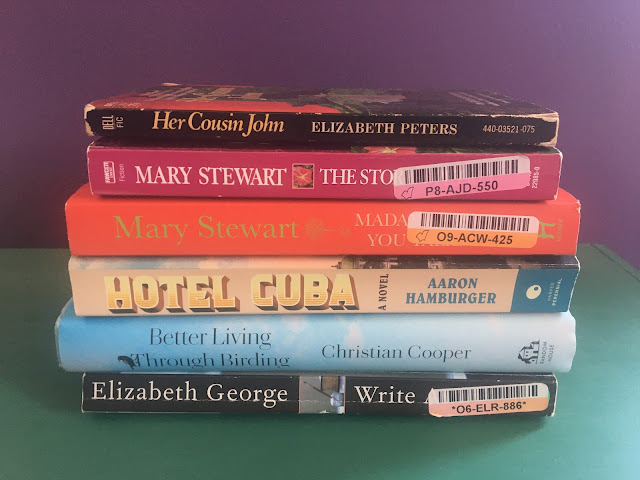
Usually I take a photo of the books I read on the last day of the month, so that even if I don't get around to posting about them for another three weeks, I at least know what they were. This time I forgot to do that and had to recreate the stack! Luckily I hadn't gotten around to putting/giving them away so I'm pretty sure this list is accurate.


After reading some heavy stuff about the former Yugoslavia in July, I had gotten onto a Mary Stewart kick for something light. I continued that streak into August with Madam Will You Talk, a fun and suspenseful romp through the French countryside (and the second of her books that I've read recently which not only relies heavily on characters smoking to give them something to do while they converse--to avoid talking head syndrome--but also to provide a significant clue to solving the mystery. Interesting how dated that device is now!). I also read The Stormy Petrel, which had such a great setup--a remote Scottish Island, two mysterious men appearing out of nowhere into the narrator's life (and cottage), and a whole bird-watching sub-plot, but I felt like she wrapped up the mystery too quickly and neatly, and while I support the instinct of using the rest of the book to resolve a conservation/land development/bird protection issue, it didn't make for suspenseful, or even all that interesting, reading. 

Back in the romantic suspense/romp through the countryside vein, I re-read (probably re-re-re-re-read) Elizabeth Peters's Her Cousin John, which has an alternate title in some editions of The Camelot Caper, because I'm interested in the caper as a genre (sub-genre?) and most suggested titles in articles about the style are by dudes. It's an entertaining and amusing book, and as a bonus it introduces a character who becomes a staple in the later Vicky Bliss series. I even found a scholarly article about it, which I also found entertaining, both the fact that someone wrote it and the article itself.

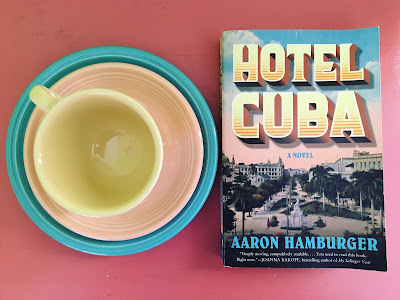
In a more serious but still thoroughly enjoyable vein, I read Hotel Cuba, the new novel by my friend and mentor Aaron Hamburger. It's based on the story of his grandmother's experience of emigrating from Eastern Europe to America via Cuba in the 1920s, when the US was not exactly welcoming of Jewish immigrants. Such an interesting peek into a slice of history.


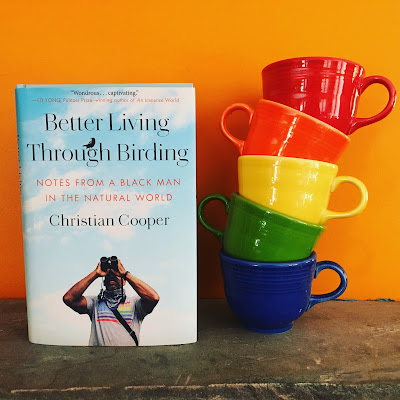
In the nonfiction realm, I read Christian Cooper's Better Living Through Birding: Notes from a black Man in the Natural World, which delves into science fiction, growing up gay, Black, and nerdy, writing comics, traveling the world, and, of course, bird watching and the notorious events of the day on which a white woman decided to call the police on him for birding-while-Black, coincidentally on the same day George Floyd was murdered by white police officers. Fortunately  Cooper came out of the incident intact and has since gone on to host a National Geographic program and do other great things around birding and social justice, as well as write this book, which is super engaging.


And, finally, I finished reading Elizabeth George's first craft book Write Away, which gives very useful advice for crafting a novel in general (not just a crime novel), the most useful of which is: 

You will be published if you possess...talent, passion, and discipline.

You will probably be published if you possess...either talent and discipline or passion and discipline.

You will likely be published if you possess neither talent nor passion but still have discipline....

But if all you possess is talent or passion, if all you possess is talent and passion, you will not be published.

 Which is to say, sit your butt down and get to work!

Friday, August 18, 2023

Book Stack ~ July 2023

  A monthly post about what I've been reading.


Vacation Reads
Before we left on our trip to Slovenia and Croatia, I searched online for "books that take place in the Balkans" and came up with the first two on the list (as well as two from last month's list).

The Tiger's Wife by Téa Obrecht. This book tells the story of a woman doctor from an unnamed city (presumably Belgrade) who travels to a coastal town in another of the former Balkan republics (also not named) to provide medical care in an orphanage. While she's there, she learns that her grandfather had gone away to a clinic and died, without telling his wife or daughter the truth about his medical condition (cancer) or where he's going. The narrator intertwines her experiences at the orphanage, including trying to help a group of Roma who are digging in the nearby vineyard for mysterious reasons, with stories of visiting the tiger house at the zoo with her grandfather as a child and then delving further back into stories of her grandfather's childhood and the escaped tiger that takes up residence near his village, and magical realism and folkloric elements become part of the narrative. It's a strange and beautiful book.

Mix Ex-Yugoslavia by Sofija Sefanovic. This memoir begins with the narrator taking part in a Miss Ex-Yugoslavia beauty pageant among the former Yugoslav ex-pat community in Australia and from there winds back through her childhood growing up in Belgrade and her family's emigration to Australia as tensions in that country rose in anticipation of war of the 1990s. While Stefanic didn't experience the war first-hand, it's still an insightful account of the experience of someone intimately tied to the place and a different perspective on NATO's role in ending that war--different from our own US roaring in as saviors story, and the collateral damage the wars had on the people living in Serbia who did not support Milošević or the ethnic cleansing.

In Croatia I visited a bookstore (okay, in both Slovenia and Croatia I visited a LOT of bookstores) and picked up the following three works in translation:

Take Six: Six Balkan Women Writers, edited by Will Firth. This collection includes stories, excerpts, and essays from six women writers who hail from six different Balkan republics. It differs from the previous two books, as well as The Hired Man, which I read last month, in that most of the stories don't focus on war. Rather, in a variety of writing styles, they delve into different aspects of everyday life of modern people, both tragic (drug use and death) and ordinary (falling in love), including a series of humorous stories that take place in ride shares and memoir vignettes by a teenager in a tuberculosis ward. 

In a Sentimental Mood by Ivana Bodrožić and Kindness Separates Night from Day by Marija Dejanović are both books of poetry translated from Croatian into English. I'm not a great poetry critic, but I enjoyed them both, especially Kindness.

When I got home, I immediately came down with a cold and spent three days lying around hydrating and not moving much, so I craved comfort reads and picked up a couple of vintage Mary Stewart volumes I'd ordered recently. Both Touch Not the Cat and The Gabriel Hounds have good gothic vibes, and The Gabriel Hounds has my other favorite suspense trope: travel to an exotic location (the desert of Lybia). They both also lean heavy on a trope favored by both Mary Stewart and my other suspense writer fave, Barbara Michaels: kissing cousins. The Gabriel Hounds is extra-squirmy, since the cousins' fathers are identical twins, which makes them, genetically, half-siblings. I don't know what it is with these authors, but they loved keeping it in the family. Is the ick factor of this a recent development in society and cousins getting together just no big deal in the sixties and seventies? 

Friday, August 4, 2023

The Long Arm of History


Mountains steep as church spires. Ancient mosaics. Streams of crystal-clear water running over chalk-white rock. A Roman emperor's basement. Twisting Medieval streets. Folk-art beehives. A bomb shelter. Opal-blue lakes. Saint's reliquaries. Deep, underground caves. Bullet holes and mortar craters. Cities the color of sherbet. Butterflies. Lizards. Storks. Swifts. Seas of red roof tiles. A sea of turquoise water. A sea of humanity.

These are just a few of the things we experienced during three weeks in Slovenia and Croatia this month. C and I wanted to take a big trip to celebrate all three kids graduating and *big* birthdays for both of us this year, and we've always wanted to travel to Europe (among other places) as a family, but the timing and the finances had never aligned. With all the fledglings perched to fly out of the nest, it felt like now or never. To make the trip happen we cobbled together our savings, sold some building equipment, and gratefully accepted support from relatives.

Our choice of destination came as a bit of a surprise--both to ourselves and to those we told about it--but after consulting a well-traveled relative and watching several episodes of Rick Steves, we concluded that the the two countries would provide exactly the kind of trip we wanted to experience: a mix of nature and culture, mountains and seashore, caves and church spires, art and architecture, and both deep and recent history. I also had a family connection--a grandfather who came from Slovenia--which added a bit of a personal journey element to the trip for me.

Slovenia felt in many ways like coming home for me--the spectacular Julian alps were not that far different than my own Colorado Rockies and the forested lowlands were every bit as green as Maine. Beyond those similarities, it was a completely different world, as clean, organized, and well-run as an imaginary land. I never saw a pothole, nor hardly a scrap of litter. Every house was charmingly built, in white or cream or pale green or yellow stucco, with a red-tiled roof, wide overhangs, and second-story balconies with decorative railings adorned with geraniums. And the houses stood in neat little villages, rather than sprawling over every inch of countryside the way they do here.The capital city, Ljubljana, is a fairyland of beautifully designed art-nouveau-style buildings, where even in the outskirts, modern skyscrapers and old communist-era apartment blocks manage to look attractive. Even industrial yards and junk piles behind farmsteads looked tidy. The people we met were friendly and kind, and the cake was amazing.

In Croatia we moved into a much more populous, much more Mediterranean land, where long arm of history exerted a greater influence and left a far less orderly imprint on the ground. Over two weeks, we wound our way up and down the stone staircases of ancient, fortified cities on the coast, visiting Roman ruins and Gothic churches. The white-hot sun beat down out of a white-blue sky and bounced back on us from the limestone walls and earth, and we sought relief in Euro-style lemonade (water with pure lemon juice; no sugar, little ice) and the Adriatic, its water a mystical aqua-blue, where, with little in the way of beaches and even less in tides, you swim off of rocks that you wouldn't dream of going near in Maine for fear of being dashed to death by the waves.

What struck me on my only previous trip to Europe--ten days in Ireland ten years ago--was the way the Medieval walls and Georgian townhouses and modern buildings were woven together into a tapestry that demonstrated that time is a continuum and we are part of history. This continuum was even more pronounced in Croatia, where in Pula a Roman amphitheater still stands among the walls of a modern, industrial city, in Split, where tourists throng through the cobbled streets of a town built by Medieval refugees within the abandoned walls of a Roman emperor's retirement palace, and in countless other towns along the Adriatic coast, where magnets and shot glasses and linen dresses are hawked from the tiny first-floor shops of the towering stone or stucco buildings from which, long ago, merchants sold bread or flax, indulgences or tinctures.

It's not hard to imagine the same steep, narrow, stone-paved streets, now thronged with tourists, instead surging with donkeys, unwashed humans, rotting produce, and waste. Here in the US we tend to keep history separate from life. We might visit Gettysburg or the Liberty Bell, but rarely is our past so starkly woven into our present. And what a history--the outer wall of Dubrovnik, the Grič tunnel of Zagreb, the forts and fortifications, all play the same role, a (often vain) attempt to protect the place, and the people, from invaders. This part of the world sits at a crossroads: between west and east, north and south. It's been battled over by the Illyrians, the Romans, the Slavs, the Ottomans, the Austrians, the Hungarians, the Venetians, among others, and, most recently, by the individual republics that made up the former Yugoslavia. You can see the signs of this latest war in the rebuilt tile roofs of Dubrovnik, where armies of Serbia and Montenegro aimed for the country's cultural history (and, across the border in Bosnia and Herzegovina, at the rebuilt Old Bridge in Mostar, where Croatian army did the same).

Despite this long, hard history, which you might expect to leave the residents bitter or careworn, we met many delightful people throughout our journey: the proprietor of the tourist farm where we stayed our first four days in Slovenia and his family; a boy who guided us to our apartment in Koper; another young man who did the same in Zagreb; the hosts of several of our apartments who went out of their way to make our stay comfortable; many of the waiters in the restaurants we ate in (most of whom took great delight in joking with us and in our attempts at "hello" and "thank you"--which was the extent of our language acquisition); the woman behind the desk at the modern art museum in Dubrovnik, with whom I bonded over being a mother of three sons, including twins.

When it came time to prepare to come home, I didn't want to leave. I was exhausted by the heat and the many miles of stone stairs we climbed every day, and I really wouldn't have minded eating a few vegetables and drinking a tall glass of ice-cold well water. But I wasn't ready to break up the family party--M would be staying behind to travel for a few additional weeks, and, after we got home, the twins would be back to their self-contained ways. I was enjoying us all being together. I also wasn't ready to give up having new and interesting places to go and sights to see every day. Somebody said the sign of a successful vacation is when you're ready to go home at the end, but for me I think it's never wanting it to end.

Friday, July 14, 2023

Book Stack ~ June 2023


 A monthly post about what I've been reading.


I started this month with a couple of fun mysteries by JS Borthwick, a writer I'd never heard of--despiete her having been a Maine writer--until I ran across her works in a used bookstore. I read her first and third installment of her Sarah Dean series. They're pretty entertaining, in the traditional mystery style, with some humor mixed in. I especially liked The Case of the Hook-Billed Kites, because it has a bird-watching theme, although I admit to getting confused by the many many characters. The Student Body was amusing because of the college that's a thinly veiled fictionalization of one of Maine's elite schools.

After that, I moved onto books related to our summer trip to Slovenia and Croatia. The first was The Hired Man, by Aminatta Forna, a novel follows the story of a man in a remote Croation town, who hires on to help restore the nearby abandoned house that a woman from England and her two teenage children move into. As he repairs the house and helps the daughter bring to life a covered mosaic, he revisits in his mind his childhood and young adulthood, recounting a friendship with the two children who lived next door and how one of those relationships blossomed and the other deteriorated. It has the tightly wound suspense of a mystery, as we sense that something very bad happened, but we don't know what or why.

I admit to not reading all 1,000 pages of Black Lamb and Grey Falcon, the classic travel account of Yugoslavia by Rebecca West, written in 1937. But I did read the parts relevant to our vacation, or a little less than 300 pages. It's a fascinating account of the region's history, people, and landscape. Maybe I'll read the rest when I get home.

Finally, I read Rick Steves' Europe 101: History & Art for the Traveler, by Rick Steves and Gene Openshaw. I took two semesters of Western Civilization in college, but that was a lot of years ago, and not a whole lot of what I'd learned stuck to the old gray cells, and I never took the opportunity to take Art History. So reading this book was both a great refresher and an introduction to art and architecture about which I only had a glancing knowledge. It's also laced with dorky but amusing dad jokes (eg., they call the Medieval dread with which the end of the 10th century was approached "Y1K." Har har.). It inspired me to want to visit a LOT more of Europe, where much of the continent's art and architecture are housed. Gotta keep on traveling.


Friday, July 7, 2023

Look, Ma! No Hands!

Twenty-two years ago, I sat on the purple velvet couch in our sweet apartment in Gardiner--the one with the high ceilings, tall windows, and claw-foot tub--with a hot, sticky, diaper-clad baby glued to my own hot, stick body and a fan blowing directly at us in our second-floor apartment in with all those south- and west-facing windows. It was July and it was hot, and that hot, sticky baby didn't want to be anywhere but glued to me. 


I'm certain that in that moment, I believed I was living my permanent reality--that I'd been glued to a hot, sticky baby since the beginning of time and I would be glued to a hot, sticky baby for all of eternity. At a time when he wouldn't even let me lay him down of his blanket on the floor (where surely it was cooler than it was attached to me), I couldn't imagine that one day he would walk and talk and ride a bike. Perhaps, if pressed, I could have acknowledged intellectually that yes, one day this little ball of sweat and misery would one day graduate college. But viscerally? No. We were as we always were and always would be, eking scant relief from an oscillating fan. I had no way of knowing that every hot, sticky day he was imperceptibly but inexorably moving away from me.

And then that day passed, and the next, and the next, and, more than 8,000 days later the inconceivable (in that moment) happened: the baby had become a man. His bald head had grown blond hair. His blue eyes stayed blue. He had learned to walk and talk and ride a bike. He had gone to school and learned to drive and traveled around Europe on his own. On the day after his twenty-second birthday, he walked across a stage and accepted his college diploma.

I brought a box of tissues with me to graduation, expecting (after a weepy moment at baccalaureate the previous day) to be a blubbering mess. But as it turned out I felt no sadness or nostalgia, but only pure joy and pride and amazement. Perhaps it was that the college had pulled out all the stops to make it a lively, joyous occasion (to the extent of ensuring--somehow; I'm certain they have the resources to do it--that the rain poured only during the night and that both baccalaureate and graduation took place in spectacular sunshine). Perhaps I was distracted by the logistics of orchestrating a large and varied group of people who had come out to celebrate with us. Perhaps any sadness I might have felt was tempered by the mountain of his personal possessions that we'd moved out of his dorm room and back into our house over the previous days.

Whatever it was that brought me that sense of peace and rightness, as he made his way among his cap-and-gown-clad peers, I knew that those long days over twenty-two short years had led exactly to where they were supposed to. I couldn't have been happier, and I didn't use a single tissue.

A version of this post went out recently to subscribers of my newsletter, along with some bonus material. Subscribe here and receive a free PDF of my illustrated short essay "Eleven Ways to Raise a Wild Child."

Friday, June 16, 2023

Book Stack ~ May 2023

  A monthly post about what I've been reading.


I had a lot going on in May, so it was a kind of light reading month, especially toward the second half.

Fiction

I picked up What the Dead Know by Laura Lippman at a used bookstore, and I really liked it. It's about the disappearance of two little girls about 20 or so years in the past, told from multiple points of view and shifting back-and-forth between the present and the time of the disappearance, with lots of unreliable narrators along the way. Her style reminded me a bit of Elizabeth George (see below). I'll be looking for more of her books in the future.

Speaking of Elizabeth George, I read her first book, A Great Deliverance, which introduces her detective duo, Inspecter Linley and Sgt. Havers, and also introduces her style of multiple points of view. It's clearly not as strong as her future books, in terms of the character motivation and development and maintaining POV, but I like seeing how authors develop.

Finally, a book that was truly on my book stack, Jennifer Weiner's Then Came You. The premise of this book is what would happen if the egg donor, surrogate, and older sister and future mother of a baby conceived and born through egg donation, in vitro fertilization, and surrogacy were to all meet. The plot that gets them together is somewhat convoluted, and the ending is tied up in a bit too neat of a bow for my taste, but it was an entertaining story that gave a lot to think about with regard to unusual family structures.

Nonfiction

The first book (which is the bottom book), was actually from April, but missed the photo shoot for last month's post. Trusting the River by Jean Aspen follows Aspen and her husband around the US as they travel, meet up with friends and family, and try to figure out what they want their retirement to look like. It's a book about aging, planning, looking back over a long and full life, and enduring terrible loss. I'd read both of Aspen's previous books, Arctic Daughter and Arctic Son about her times in the Alaska wilderness as a young woman and, later, with her second husband and their young son. And I recently discovered her and her husband's documentaries, Arctic Son and Rewilding Kernwood, the first about building their magical homestead in Alaska and the second about restoring it to its natural condition after the loss of their son and the realization that they were getting older and would be unable to maintain it, while meanwhile encroachment on the wilderness by hunters was making the home vulnerable to vandalism. I really admired Aspen's wisdom in both documentaries and was excited to find she'd written another book. The book is lovely and gives a lot to think about, and fills in a lot of the narrative around her life before and after the other two books. I also think it could have benefitted from a good editor, as it meandered a lot. Still, I enjoyed reading about the full trajectory of a fascinating life and I appreciated the intention with which Jean and her husband approached their later years.

Finally, I don't often pick up a book as soon as I hear about it, but after listening to two interviews with Mary Louise Kelly on NPR, I grabbed a copy of It. Goes. So. Fast., about the senior year of her oldest son. The book begins with the realization that this is her last chance to be there for her kids, after years of having to make sacrifices in favor of being an international correspondent and news anchor on All Things Considered. Few motherhood memoirs encompass the teenage years, so I appreciated Kelly going there, and I really appreciated her honesty and her laying bare the challenges she has faced as a mom over the years. It's brave for anyone to do that, but especially so for a public figure. I also love the new life philosophy I got from the book, to whit: "Why should things be easy when they can be difficult?" Amen, sister.

Related Posts Plugin for WordPress, Blogger...