Showing posts with label trees. Show all posts

Friday, March 11, 2022

Flash Friday ~ The Oak


The oak came down on Thursday morning. The sky was blue, the temperature around 34 degrees to start, later warming to nearly 50, which in March is balmy. Our arborist friends put a rope around its limbs, above the point where the trunk split into two leaders, threaded the rope around a distant maple tree, and hooked it up to the winch on a blue tractor. 

The arborist cut a notch out of the base of the tree, near the ground, on the north side, the direction it was intended to fall toward. Then he cut lines perpendicular to the notch and began the working the chainsaw into the meat of the tree. The bar was not much longer than the thickness of the trunk, and he came at it from different angles, until only a narrow strip of bark on either side of the notch remained intact. I thought about how the living tissue of a tree is only a thin layer of cells beneath the bark, how those two strips of connection might be enough to keep the tree alive, until a windstorm took it down.

The arborist turned his saw off and all was quiet for a moment, then the winch started up, pulling the rope taught. The oak stood up, vertical, its limbs reaching toward the sky; it had developed a houseward lean over the years, reaching for the sunlight that grazed the roofline from the south. Then it tipped over and lay down almost gently among the scrubby saplings that grow on that side of the house, its own twigs and branches breaking its fall.

The oak was originally scheduled to come down in November, when I would be gone, visiting my family in Colorado. I measured it before I left, wrapping my dressmaker's tape around it at chest height: 57 inches in circumference, making it 18 in diameter. Later, after the arborists left and the tree lay in the yard in bucked-up cordwood lengths, I measured the stump at ground level: 27 inches across its widest dimension.

I have a picture of the oak from when out house was a framed-in box of raw wood. I stand where one day our purple front door and a granite step will be, holding M, a few weeks old, all big head and scrawny limbs. The tree stands in the foreground, and because of the perspective it's hard to say how big it is, but it looks almost small enough to wrap my two hands around. Counting off the thick growth rings of the last twenty years, it appears it was about eight inches in diameter then, meaning it's more than doubled in thickness in less than half its life.

We never intended to keep the oak. C had cut down most of the trees that inhabited the little, mostly bare, knoll where we planned to build our house. The oak tree he'd left for some reason--he thought it was too far from the house's footprint to bother with, perhaps, or he figured the excavators would take it down with their bucket. As it turned out, however, the tree was too close to the foundation for comfort--its roots would eventually gnaw at the basement walls, its branches overhang the roof and encroach on the chimney--and the excavators went to great lengths to avoid knocking it down. 

Because they'd saved it, we let it stay, leaving a little well around its base for water to collect in and to allow some of the roots to breathe when we backfilled the front yard. I planted white-and-apricot daffodils in that well. Our first clothesline hung between the oak and a poplar in the scrubby area north of the house, where I hung M's diapers, gathering them in in the twilight to an audience of mule deer. Each summer I'd hang the hummingbird feeder from the clothesline. We strung the hammock between the oak and a hemlock nearby, and I whiled away many summer hours reading and writing and daydreaming in its swinging embrace, the dappled shade of the oak leaves filtering the sun.

Then the brown-tailed moths came. The first caterpillar dropped from a different oak tree in the yard onto the back of my shirt. The rash formed in minutes, covering me from chin to shoulder in an angry, stinging red patch of raw meat. I am a sweller and an itcher, reacting redly to everything from cheap jewelry to synthetic waistbands. Mosquito and blackly bites give me welts; bee stings swell to the size of footballs; don't even think about fire ants and chiggers; poison I've spreads and weeps and oozes. But none of these irritations have kept me indoors. However, for weeks after my brown-tailed moth run-in, every time I stepped outside, my skin erupted in goosebumps. Burn the trees down, I thought. Burn them all down!

We did not burn the trees down, and we tried to live with the moths. For the first time ever, I prayed for a cold wet spring. But they kept coming and coming. By night the caterpillars would rain out of the oak tree and by day they would climb up the front of the house. I knocked them off with a twig into a bucket of soapy water. One day I counted more than 200 caterpillars caught in my bucket. C considered pruning the tree back, to keep it from overhanging the house, but our arborist friend issued the death sentence: take it down; take the whole tree down. Not long after the poplar, where the other end of the blackened clothesline was tied, long-dead and swollen with water from a rainstorm, collapsed on a still day. A sign.

After the tree was cut and bucked, it lay in the yard, the chunks of log giving off the vinegary smell of cut oak. When Z got home he asked why we hadn't left the log whole, to be cut into lumber, and I felt panicky ache in my chest, the feeling of having made a mistake you can't undo. The tree could have yielded the wood for the quarter-sawn oak end table I've always wanted. It could have ended its life with a little more dignity than sixteen-inch chunks of cordwood. We could have honored its place at the front door of our home for the first twenty years we lived here, but instead we will burn it, to keep that home warm, the tree reduced to nothing but smoke and ash and heat.

You can order my book, Uphill Both Ways: Hiking Toward Happiness on the Colorado Trail from any of the retailers listed here, or ask your local bookstore or library to order a copy. And if you want more Andrea, you can subscribe to my newsletter here.

Friday, February 4, 2022

Flash Friday ~ Extraordinary Days


I'd planned to go birdwatching my first morning in Mexico, but I didn't make it farther than the balcony of my hacienda, where a cacophony of new and unfamiliar birdsong filled the new and unfamiliar trees. I sat with my binoculars, my journal, my bird books, and a cup of tea and watched as great-tailed grackles, great kiskadees, Yucatan jays, a Yucatan vireo, an Altamira oriole, a golden-fronted woodpecker, and a plain chachalaca paraded through my temporary backyard. These are, no doubt, the crows, blue jays, and cardinals of the Yucatan Peninsula, but to me they were rare and wondrous sightings. On the ground below, a Mexican  agouti--a cat-sized rodent that looks like a guinea pig that swallowed a squash and is trying to walk on stilts--traipsed past the swimming pool. 

The trees, vines, and shrubs planted in the lush and meticulously maintained gardens and all things you might buy at the garden center to keep in a pot, only super-sized. Coconut palms grew right out of the sand on the beach, just like they do in cartoons. Beyond the walls of the resort, the jungle grew in a dense, impenetrable tangle. Over the next several days, I watched a troupe of howler monkeys parade across the tops of walls (tiny ones clinging to their mothers' bellies) and saw white-nosed agoutis nose among the tables of an outside dining area. I sat in the plaza one morning and watched two actual parrots steal a woodpecker's stash of seeds from the hole in a dead palm tree. I snorkeled in the warm, salty, and buoyant water of the Caribbean, watching schools of sequined fish flash among the coral, anemones, and urchins. I snorkeled in the cold, mineral water of a cenote, where sunlight filtered blue in the water, tiny fish nibbled at my skin, and scuba divers disappeared into a deep, scary cave. 

I purchased junk food in a Mexican grocery store, where real shoppers bought plastic bags of raw pork, packets of dried chiles, and heads of iceberg lettuce. I practiced my extremely rudimentary Spanish by asking every shop owner in the contrived local marketplace, "Tienes los sellos para postales? Donde esta los stampitos?" With no suerte (selling stamps, or sending postcards, it would appear, is not the done thing).

I rode a rusty bicycle among the Mayan ruins at Coba and followed its song to the most spectacular bird, the black-headed trogon (see above). With each "bop, bop" of its tune, it would splay its black-and-white striped tail feathers in a V, while staring at me with that intense blue-ringed eye. 

This is why we travel, is it not, to find the extraordinary in what, to the people who live there, are likely ordinary, everyday experiences? To shake up our notions of what's expected and see the world through new eyes?

Tuesday, May 4, 2021

April Delights


 This winter was long, longer than most, despite its relative snowlessness (another reason to read apocalypse in the tea leaves). March brought no relief. It never does. But April, despite what Eliot said, is perhaps the kindest month. Warm breezes and wild flocks migrating north, even in years when the snow hangs around until Earth Day (this year the old snow was long gone, but a new dusting sprinkled down on the 22nd). And though I'm a Leo and a summer girl through and through, April may be my second favorite month. As the world begins to wake up, so too do I, turning outward and uncurling from a winter's introspection, which always, inevitably, leads to moroseness. And so I thought I'd take stock of what's waking me up and bringing me joy this April. 

Balloons
My father-in-law is a hot air balloonist. But that does not mean he hands out rides in the basket like candy. I've been up only once, long, long ago. Earlier this month, when he was taking the balloon for its post-inspection trial flight, he took E and Z along for the ride. C and I served as chase crew, and it was like a small miracle to see our two youngest children ascend into the sky in a rainbow.

Birds
April is the month the birds return, and with no leaves on the trees and none of those pesky other b-words trying to suck my blood, it's the month for bird watching. I made a resolution to bird every day this month, and I've managed 18 so far. A first-of-year bird appears almost every time I go out. This week's new arrivals: yellow-rumped warbler, belted kingfisher, American kestrel, broad-winged hawk, and hermit thrush.

Butterflies
Yesterday I stalked a velvety chocolate-brown mourning cloak through the woods. These butterflies overwinter as adults and are always the first to appear and a sure sign of spring. I was amazed a few days earlier to see a little blue butterfly, a northern spring azure, perhaps. I chased it through the field, it flashing luminous blue upper wings while I tried to sneak up to take its picture. Now I'm aquiver with anticipation of butterfly season.

Buds
I have no doubt that social media will usher in the downfall of civil society. Nevertheless, it has its good points. For instance, I've been keeping a close eye on the flower buds of trees and shrubs in the woods around our home and snapping phone photos when the buds open and sharing them on Instagramand Facebook. It's made me much more attentive to the slow unfolding of spring, and I'm discovering that there's much about tree flowers I've never noticed, like the flowering twigs of aspen and yellow birch are high out of reach, and oak flowers, which come out after the leaves, I've never seen before.

This post went out recently to subscribers of my newsletter, along with some bonus material. You can subscribe here.

Wednesday, April 22, 2020

Faith in a Seed

"Deep within the arboretum across the street from my office, along the edge of a field of raggedy wildflowers, sixty American chestnut trees grow in four neat rows. The trees were planted fourteen years ago, on a sunny but cool morning in June. My husband worked at the arboretum at the time and invited teams of draft horses to plow the furrows into which he planted the knee-high whippets just dug from their nursery beds. I took our infant son, Milo, to the arboretum that day, to watch the enormous horses draw plows that peeled back wide strips of sod, to see his father lower tiny trees into the ground. Milo, two weeks old at the time, snuggled deep in a front pack, his still-wobbly head asleep against my chest. Neither horse nor tree made an impression on his newborn mind. I might have forgotten the day myself, if not for the momentousness of it being our first big outing after his birth, the connection of his father to the event, and the proximity of the arboretum to my workplace, allowing me to return and visit the chestnuts years later."


So begins my essay, "Faith in a Seed," which took me years to write and even longer to get published (this is, unfortunately, my processslow writing). Still, I'm thrilled that it's found a home in a very local publication, the 2020 issue of Sprire: The Maine Journal of Conservation and Sustainability. You can read it now, here, if you're so inclined, and while you're there, check out the other offerings in the issue. And please do come back and let me know what you think in the comments.

Wednesday, December 4, 2019

Holiday Countdown Week 1 ~ Greenery

Thanksgiving came so late this year that there wasn't the usual lull of late November before the Christmas rush began, but instead here we are catapulted from one holiday to the next. We actually got our tree in November this year (which is anathema in this house, but at least it was the last day in November), because M was home for the weekend and we didn't expect to see him again until the weekend before Christmas.


My brother and my sister-in-law were also visiting for the weekend, so they joined us on our tree-getting expedition, which every year involves tromping through the woods and sizing up several dozen balsam firs and making the same tired jokes about taking a 30-foot tall tree or a hemlock, and pagan ritual of thanking the tree for givin its life to bring greenery and light into our lives. The tree right now is standing naked in our living room, until another weekend comes when we can rearrange furniture and haul ornament boxes up from the basement.


Once we settled on and sawed down a tree, we collected some extra greenery for wreath-making. Most years we go to wreath-making party at a friend's house and/or buy wreaths from one of the kids. This year our friend had her party the same weekend my brother was visiting, and, though E and Z were supposed to be selling wreaths for school, they both forgot about it until the last minute and couldn't find their order forms.


This was my sister-in-law's first wreath-making experience, and she did much better than C and I did the first time we made wreaths, back in our first apartment, when we bent green boughs into somewhat circular shapes and wired them together. They were a little wonky but had gorgeous bows that C had brought home from the gardening company he worked for that year. The next time, we wired boughs onto a wreath form, but it took a few tries before we learned about making bundles of fir tips and wiring those to the form. We still don't have the symmetry thing down, but someday we'll get there.


The traditional Maine Christmas wreath is made of balsam fir, which is what we used as the base, but we also incorporated spruce, hemlock, and white pine, as well as winterberry and red dogwood stems, for variety.


C went even wilder, literally, with a disk of larvae chambers from a wasp's next, pine cones, sumac fruits, and a polypore mushroom.


My brother and sister-in-law live in a condo, so they couldn't take theirs home with them. It now hangs on the playhouse, providing a little cheer and extra cover to the chickadees who visit this feeder.


We may be slow to get this whole holiday train moving, but at least we've got the greenery, just in time for the world outside to turn white.

Wednesday, May 10, 2017

Wild Wednesday ~ Serviceberry Flowering

The trees in our woods have been flowering for a while, starting with the quaking aspen back in April. But most of them, so far, have been of the subtle flower type—catkins and tiny maple blossoms—easy to miss if you're not paying attention and not exactly showy, flower-flowers. The first of those to come alive around here is the serviceberry.


Serviceberry is also known as shadbush, because it blooms at the time shad, or alewives, run up the rivers to breed, and back in Colorado, C and I used to work in a national forest with an area known as Sarvis Creek Wilderness because, apparently, they're called sarvisberry there (one ranger we knew even named his sone Sarvis after the shrub).


Because not much has leafed out yet, they're very visible and easy to spot from a distance, though I have to admit this is the first spring that I've taken the time to get up close and personal with them.


I'm pretty sure these are Allegheny serviceberry (Amelanchier arborea), one of the two species in Maine that grow into a small three (the other five being shrubs), because the emerging leaves are reddish and not downy.


The flowers are pretty, large for a tree flower, white, and five-petaled. My book says they smell sweet, but I couldn't detect an odor in these (maybe all the rain we've had lately has washed it away).


The twigs and leaves are alternate and the buds, before they open, sharply pointed.

The bark is smooth and gray and at this stage, almost indistinguishable from red maple (the tree in the center is maple, to two on the outside are serviceberry). If you look very closely you can see faint vertical lines on the serviceberry bark.


And if you look straight overhead, the branches are so intertwined, you might think you're seeing things: a tree with red maple leaves and showy white flowers.

What's blooming in your neck of the woods?

Wednesday, May 3, 2017

Wild Wednesday ~ The Great Unfurling

Doesn't it seem to you like you wait and wait and wait for spring and then suddenly it's here and somehow you missed it? This year—this morning, in fact, I think I caught the moment of spring, which is, appropriately enough, a verb as well as a noun. The trees are in the midst of opening up their buds and unpacking their flowers and leaves and shaking them out in the sun.


In other exciting nature news, several days of rain have added a bit of water to our gravel-pit pond, and at least three painted turtles have made themselves at home.

Wednesday, April 26, 2017

Wild Wednesday ~ Finally Spring!

This post is a week late. I keep thinking about blogging, but then I spend the time doing other things instead (turns out there are only so many hours in the day—and only so much creative energy in the day). In any case, we had beautiful, warm, sunny, dry, perfect weather on Easter (a week ago this past Sunday), a day that finally ushered in spring.


The first flowers appeared in the lawn—blue-striped squill and yellow crocus (I know, not exactly wildflowers, but still, spring!!).


And the first flowers appeared in the wild. Coltsfoot.


And willow catkins. Other trees and shrubs have been flowering, too—aspen, alder, red maple. I've been remiss in getting out with the camera (maybe next Wednesday).


Meanwhile, our gravel pit is dry, dry, dry. This is the same pond where I saw a pair of otters three years ago. I don't think any otters will be stopping by anytime soon. And I wonder where all the turtles have gone (especially the snapper the size of a trashcan lid I saw down there once). I don't hear any frogs coming from the pond, either (but I do hear them in a nearby alder swamp—spring peepers, wood frogs, and American toads so far).

Wednesday, March 1, 2017

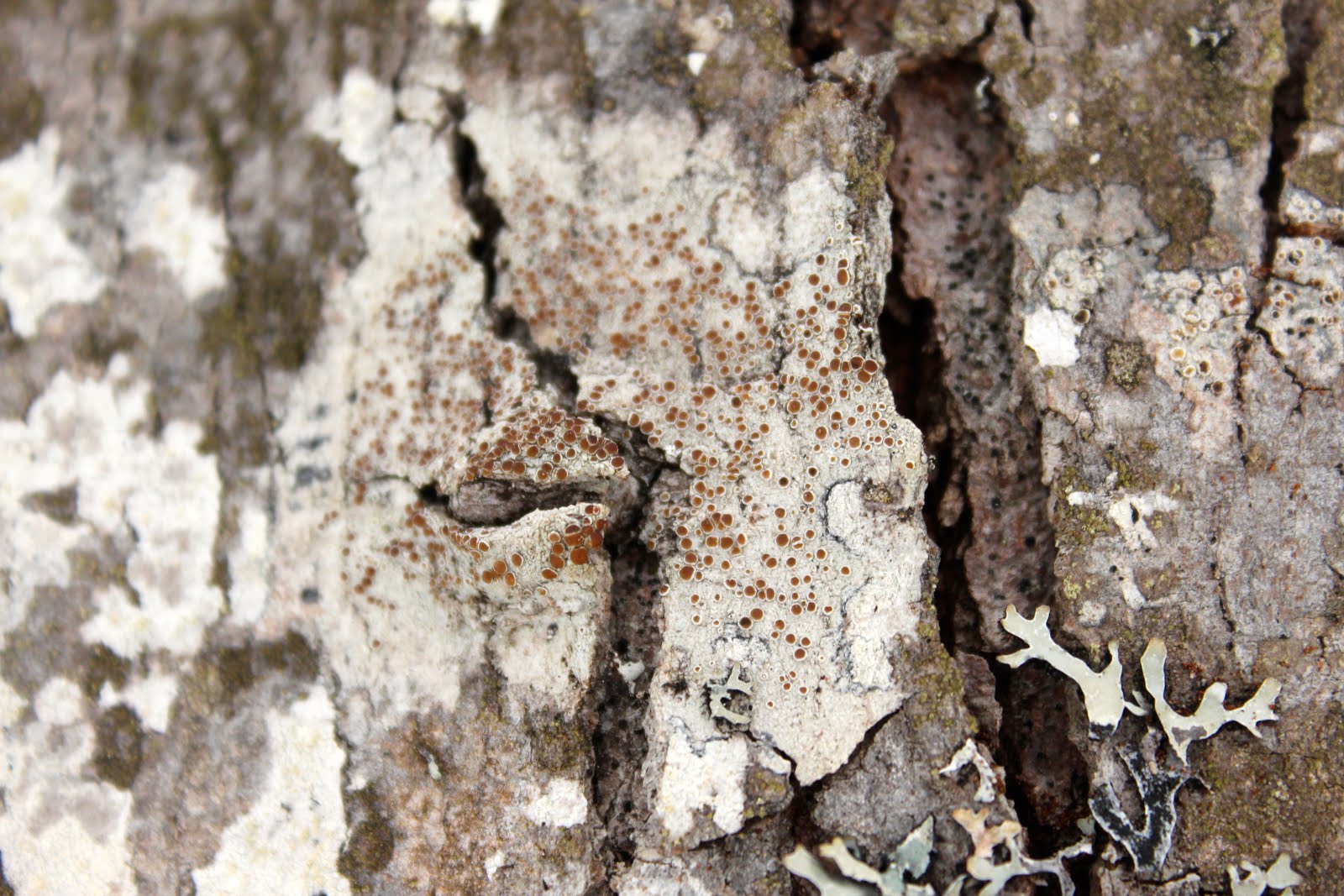
Wild Wednesday ~ Lichens Tree


A week or so ago, I was walking in the woods and came upon this tree that appeared to be covered in every type of lichens imaginable. Lichens are organisms up of members of two or three different kingdoms. Fungi form the structure of the organism and either algae or cyanobacteria, or both, create food for the organism through photosynthesis. We just brushed over lichens in our Master Naturalist training, and to be honest, I have not pursued the subject with a great deal of vigor (I can't even find my lichens key—need to do some organizing). But I do remember that license are divided into three major groups based on their form and this tree had specimens of all three.

Crustose lichen holds tight to the surface it grows on, almost like paint; i.e. it forms a "crust" that is virtually impossible to separate from the rock or bark it attaches to.

Foliose lichen are more leafy in appearance (think "foliage"). The leafy bits are called "lobes" and they're either attached to their substrate with rhizines or, in the case of umbilicate lichen, from one central attachment point. 
Fruticose lichen grows in a shrubby, branching pattern. The shrubby part is called the "thallus" and the attachment point the "holdfast."

This tree was a festival of life. Along with the many types of lichen, it had this little patch of moss.


And this little guy, which looks like it could be a lichen, but is actually a liverwort, which is a type of nonvascular plant.


So what kind of tree was this that so bloomed in February? I must confess I almost forgot to notice (you might say I couldn't see the tree for the micro-forest). But I did remember to arch back and look up at the branches—opposite—and I snapped off a twig, just to be sure: red maple (it's hard to tell in this picture, but red maple twigs and buds are red and the buds grow opposite of each other.

As my college bio teacher used to say, "Life is so cool; it goes anywhere!"

Monday, December 12, 2016

Getting Our 16th Tree

As we prepared to go out and get our tree Saturday, it occurred to me that this will be our 16th tree that we've gathered off this land—the first one being when M was just a baby and our house was just a shell covered in silvery house wrap. So of course I had to go in search of photos from Christmas Trees Past—these are from 2006:


Our tree-getting ritual has looked pretty similar all of these years—only the babies get bigger and bigger, and move from slings to backpacks to sleds to their own sturdy feet. 


This year they trouped ahead, in search of their own vision of the perfect tree, each of them casting their vote for a hemlock here, a spruce there.


As always, however, we keep up the search until the perfect balsam fir appears.


And then another and another.

We argue the merits of each, until our toes get cold and we get thirsty for hot cider.
They're taller now—the boys and the trees—and we pick one that towers over us a bit, cutting it down and then trimming it to the top seven or eight feet. 

This makes for a sturdier trunk, than the old saplings we used to bring home, and often (though not always) denser branches.

This year we aimed for a tree whose angled upward, hoping that, laden with ornaments, they would end up more horizontal than droopy.

We said our words of thanks to the tree, for bringing light and life into our home this dark and cold wintertime, and E and Z did the honors, sawing it down and then cutting it to length and clipping away extraneous branches.
We take the tree home and set it up in the space we've cleared and cleaned in anticipation. And then we put on Christmas records and decorate, a process that everyone loses enthusiasm for far too soon.


This year's tree is big and sturdy enough that it holds every single one of our numerous ornaments, including the "normal" ornaments that E specially requested—a box of gold glass balls that I bought at Kmart, back when C and I didn't have enough ornaments to fill out a small tree, as hard to believe that there ever was such a time. 


Finally we place the elf in his place of honor, at the top, hugging the glass star, ready to preside over our festivities of the season.
Related Posts Plugin for WordPress, Blogger...